Polar Coordinates
Introduction
In this section we're going to examine an alternative to the rectangular coordinate system we've grown accustomed to. Rather than plotting points of the form $(x,y)$, where $x$ and $y$ correspond to placement along two perpendicular axes, we're going to plot points of the form $(r, \theta)$, where $r$ is measured in a straight line from the origin and $\theta$ is angle taken counterclockwise from the positive $x$-axis.
Plotting points in polar
Just like with rectangular coordinates, we assign each point in the plain an address in the form of an ordered pair. In polar coordinates, these ordered pairs take the form $( r, \theta )$.
- $\theta:$ angle measured counterclockwise from the positive $x$-axis (just like in the unit circle).
- $r:$ distance from the origin. The weird thing with $r$ is that it can be negative. When $r<0$, we just walk backwards.
Here are some examples:

Polar Points
Notice that the point $( -2, \pi / 4 )$ is in the third quadrant. That's because we faced the $\pi/4$ direction, but walked backwards.
Conversion formulas
We already know everything we need to to convert back and forth between polar and rectangular coordinates. Consider an arbitrary point with both labels:

Polar ~ Rectangular
Right away we can see that, from the pythagorean theorem $r^2 = x^2 + y^2$. And, from basic trigonometry, $\tan{ \theta } = \frac{ y }{ x }$. So given a point of the form $(x,y)$, we can convert to polar form using
$$\begin{cases} r^2 = x^2 + y^2\cr \cr \tan\theta = \frac{y}{x} \end{cases} $$
Because there are many combinations $(r,\theta)$ satisfying these equations, we'll have to be careful about how we combine $r$ and $\theta$ values. That will be made clearer with some examples.
Since $\sin \theta = \frac{y}{r}$ and $\cos\theta = \frac{x}{r}$, we can covert from polar to rectangular using
$$\begin{cases} x = r \cos \theta\cr \cr y = r \sin \theta \end{cases} $$
Example 1
Convert $(r,\theta) = (2, 2\pi / 3 )$ to rectangular coordinates.
Solution
$$\begin{cases} x = 2 \cos 2\pi/3 = 2(-1/2) = -1\cr \cr y = 2 \sin 2\pi/3 = 2(\sqrt3/2) = \sqrt3 \end{cases} $$
So, $(2, 2\pi / 3 ) \Longrightarrow (-1, \sqrt3)$.
Example 2
Convert $(r,\theta) = (-4, \pi / 6 )$ to rectangular coordinates.
Solution
Before we do the conversion, think about where on the plane this point lies. We should make sure that our answer lies in the same quadrant.
$$\begin{cases} x = -4 \cos \pi/6 = -4(\sqrt3/2) = -2\sqrt3\cr \cr y = -4 \sin \pi/6 = -4(1/2) = -2 \end{cases} $$
So, $(-4, \pi / 6 ) \Longrightarrow (-2\sqrt3, -2)$.
Example 3
Let's go the other way. Convert $(x,y) = (-6, 6)$ to polar.
Solution
$$\begin{cases} r^2 = (-6)^2 + (6)^2 = 72\cr \cr \tan\theta = \frac{-6}{6} = -1 \end{cases} $$
Notice that we get two answers for $r$ and infinitely many answers for $\theta$:
$$ \begin{cases} r = \pm \sqrt{72} = \pm 6\sqrt2\cr \cr \theta = \frac{3\pi}{4}, \frac{7\pi}{4}, -\frac{\pi}{4}, -\frac{5\pi}{4}, \dots \end{cases} $$
As we said before there are infinitely many options for how to express a point in the plane in polar coordinate, but not every combination of these values of $r$ and $\theta$ will correspond to the point $(-6,6)$. We want to make sure that our point $(r,\theta)$ lies in the second quadrant. Here are a few options:
$$(-6, 6) \Longrightarrow (6\sqrt2, 3\pi/4) $$
$$(-6, 6) \Longrightarrow (-6\sqrt2, 7\pi/4) $$
$$(-6, 6) \Longrightarrow (-6\sqrt2, -\pi/4) $$
Polar Plots
When plotting in polar, we typically take $r$ to be a function of $\theta$. In doing so, we get curves that are much different than the curves we get as functions of $x$ in rectangular coordinates. Here are a couple examples animated as $\theta$ goes from $0$ to $2\pi$ (you won't be responsible for knowing these):

$r=1+\cos\theta\sin\theta$

$r=\cos2\theta + \sin\theta$
Let's start more simply by just consider what happens when we plot the curves corresponding to equations of the form $r = \text{[constant]}$ and $\theta = \text{[constant]}$.
Example 4
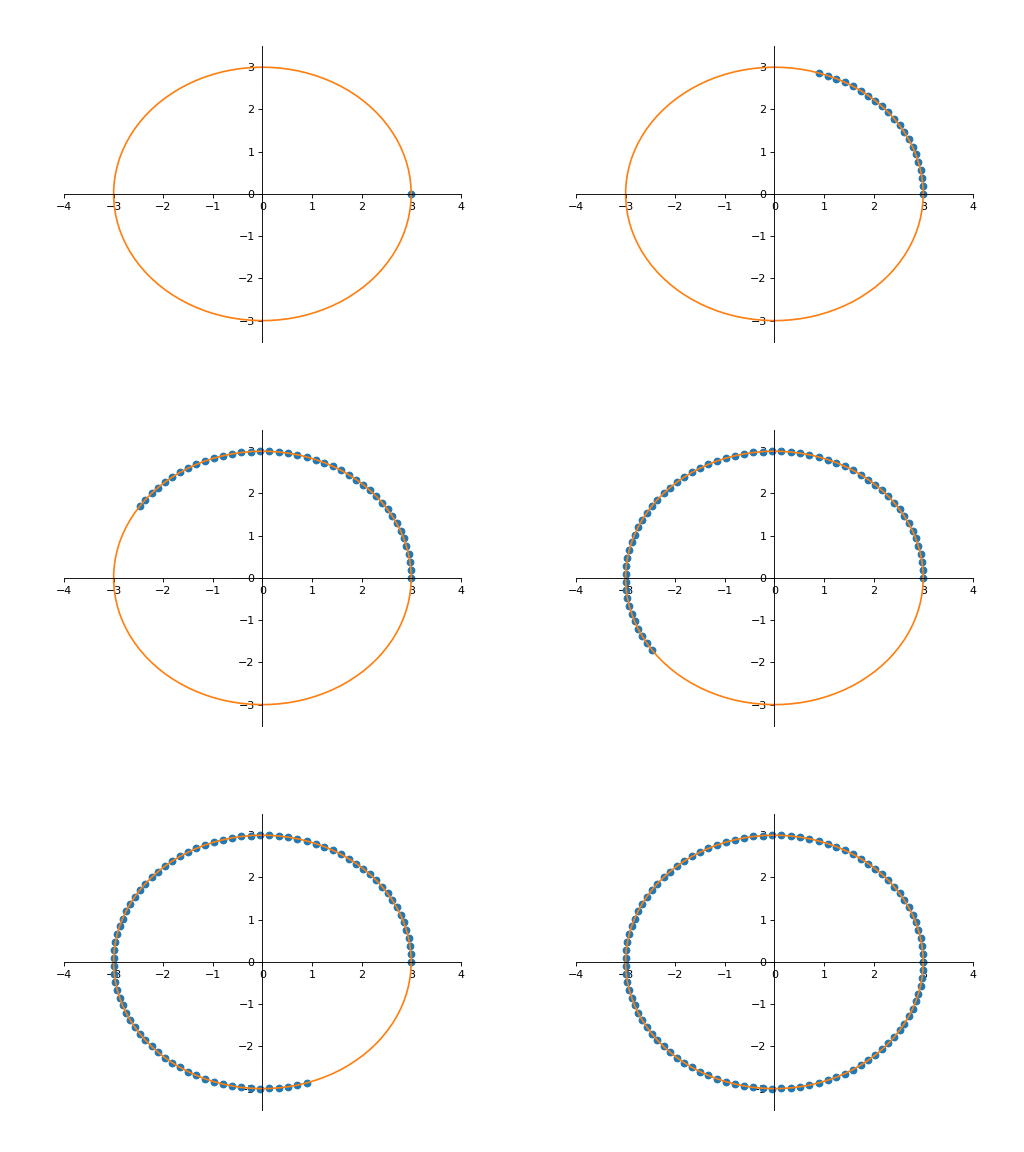
Consider the equation $r=3$. We want to plot all the points in the plane with an $r$-coordinate of 3. Since $r$ measures distance from the origin, this means that we want all points that are 3 units from the origin: its a circle. Below, $r=3$ is plotted and animated as $\theta$ goes from $0$ to $2\pi$.
$r = 3$
Example 5
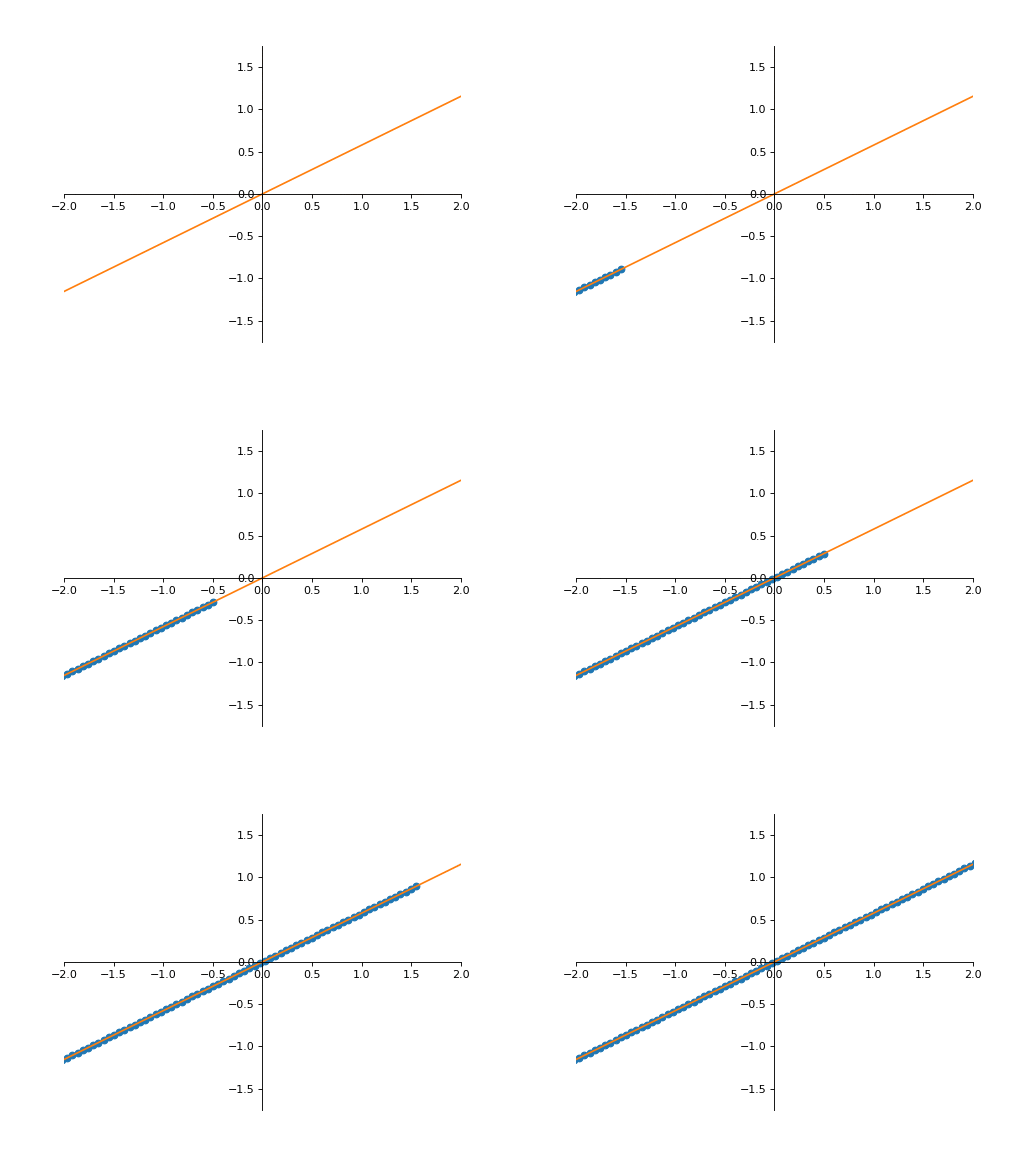
What if we set $\theta$ equal to a constant, say, $\theta=\pi/6$? Then we want all points of the form $(r,\pi/6)$, where $r$ can be any value, positive or negative. In this case, we get a line. Below, $\theta = \pi / 6$ is plotted and animated as $r$ goes from $-4$ to $4$.
$\theta = \pi /6$
Example 6
Now let's look at some functions of $\theta$. For example, consider $r = 2\cos\theta$. Let's start by making a table of some values.
| $\theta$ | $r$ |
|---|---|
| $0$ | $2$ |
| $\pi/6$ | $\sqrt3$ |
| $\pi/4$ | $\sqrt2$ |
| $\pi/3$ | $1$ |
| $\pi/2$ | $0$ |
| $2\pi/3$ | $-1$ |
| $3\pi/4$ | $-\sqrt2$ |
| $5\pi/6$ | $-\sqrt3$ |
| $\pi$ | $-2$ |
Notice that we're already back to where we started! If we carefully plot these points we get the following picture:

$r = 2\cos\theta$
Here I've animated the graph for $0\leq\theta\leq 2\pi$, so it goes around the circle twice. This will be important when we talk about integrating functions in polar.
We can show that this is definitely a circle by manipulating the equation $r = 2\cos\theta$ a bit. First, multiply both sides by $r$. Then we have
$$r^2 = 2r\cos\theta $$
We saw earlier that $r^2 = x^2 + y^2$ and $r\cos\theta = x$. So we have:
$$x^2 + y^2 = 2x $$
Now, complete the square:
$$x^2 + y^2 = 2x $$
$$x^2 - 2x + y^2 = 0 $$
$$x^2 - 2x + 1 + y^2 = 1 $$
$$(x- 1)^2 + y^2 = 1 $$
This is the equation for a circle with radius 1, centered at (1,0).
Generalizing a bit, we'll find that any equation of the form $r = a\cos \theta$ creates a circle centered at $(a/2, 0)$ with radius $a/2$.
Example 7
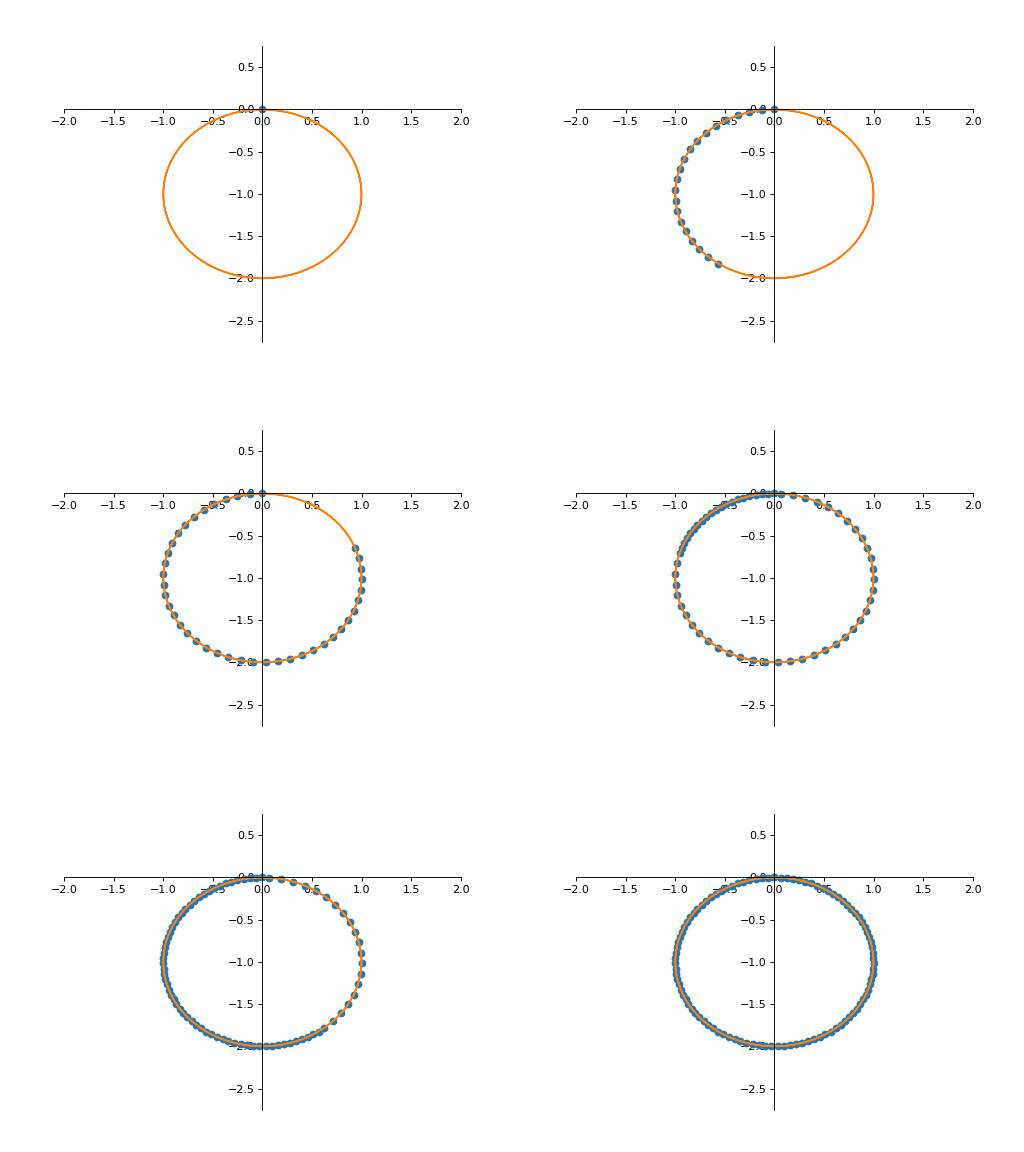
A similar thing happens when we consider equations of the form $r = a\sin\theta$. For example, let consider $r = -2 \sin \theta$. Repeating our multiply by $r$ and complete the square trick, we get
$$x^2 + (y+1)^2 = 1 $$
Here it is plotted and animated:
$r = -2\sin\theta$
Again, we go around the circle twice over $0\leq\theta\leq 2\pi$.
Example 8: Cardioid
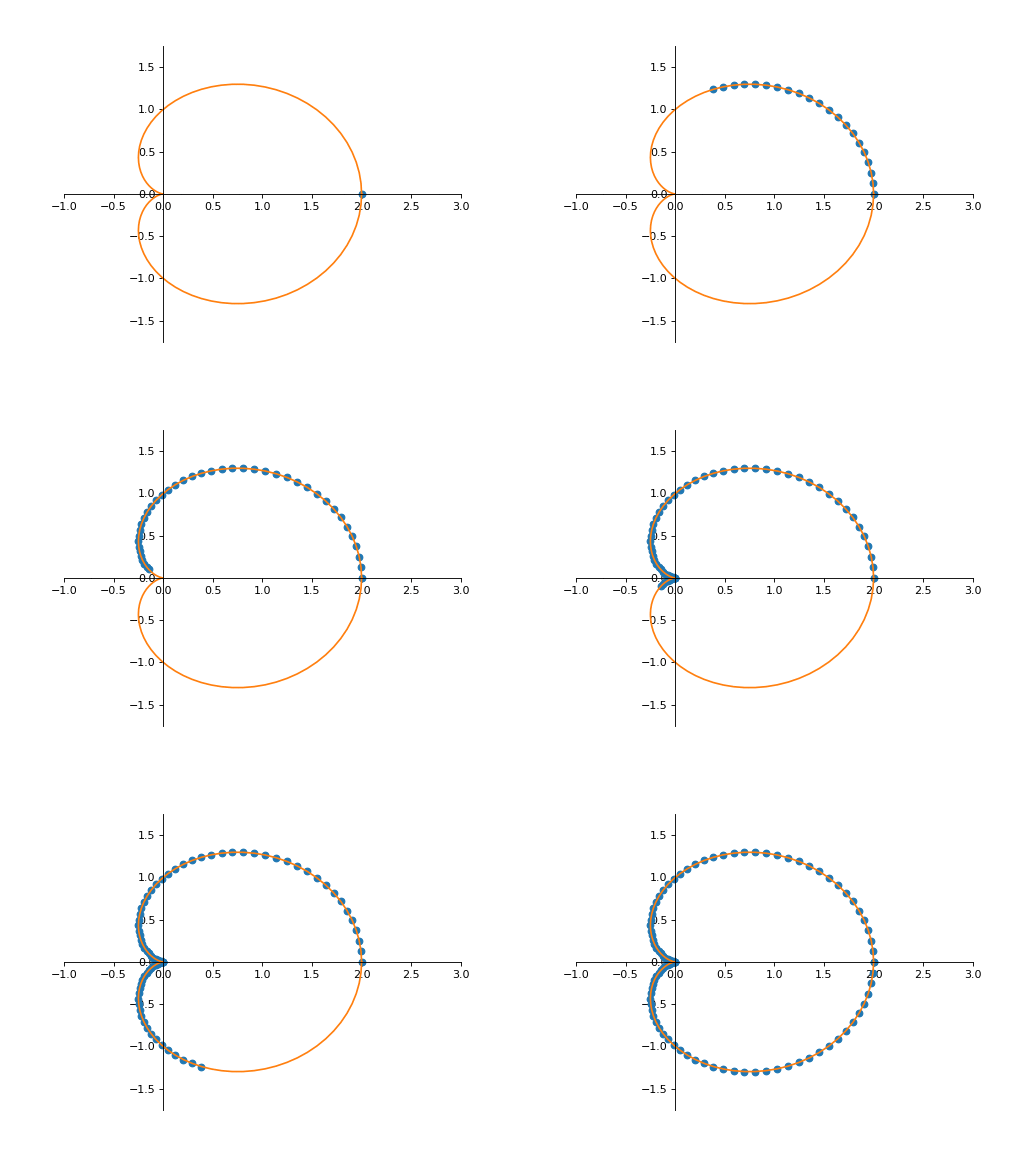
One important polar curve that you've probably never encountered before is the Cardioid. Consider the equation $r = 1 + \cos\theta$. Let's start by plotting some points:
| $\theta$ | $r$ |
|---|---|
| $0$ | $2$ |
| $\pi/6$ | $1+\sqrt3/2$ |
| $\pi/4$ | $1+\sqrt2/2$ |
| $\pi/3$ | $3/2$ |
| $\pi/2$ | $1$ |
| $2\pi/3$ | $1/2$ |
| $3\pi/4$ | $1-\sqrt2/2$ |
| $5\pi/6$ | $1-\sqrt3/2$ |
| $\pi$ | $0$ |
Because $\cos\theta$ is even (i.e $\cos-\theta = \cos\theta$), we'll get the mirror images of these points over the $y$-axis. Here it is plotted and animated for $0\leq\theta\leq 2\pi$.
$r=1+\cos\theta$
Generalizing: cardioids take the form $r=a(1+\cos\theta)$ and $r=a(1+\sin\theta)$
An application: The cardioid is a common polar pattern in microphones. The polar pattern of a microphone describes how sensitive it is to sound coming from various angles.