Parametric Equations
Outline
- Sketching parametrically defined Curves
- Taking speed and orientation into account
- Eliminating the parameter
- Doing calculus with parametric equations
- Tangents
- Arc length
Sketching parametrically defined Curves
Consider the following two parametrically defined curves:
$$ A: \begin{cases} x(t) = t\cr y(t) = t^2 \end{cases} $$
$$ B: \begin{cases} x(t) = -2t\cr y(t) = 4t^2 \end{cases} $$
Let's make some tables of values for these by plugging in various $t$ values. For $A$, we'll plug in values in $:
| $t$ | $(x,y)$ |
|---|---|
| -1 | $(-1, 1)$ |
| -1/2 | $(-1/2,1/4)$ |
| 0 | $(0 , 0)$ |
| 1/2 | $(1/2, 1/4)$ |
| 1 | $(1 , 1)$ |
For $B$, let's plug in $t$ values in $[-1/2, 1/2]$ (we're doing this to keep the $x$-values between -1 and 1 for both).
| $t$ | $(x,y)$ |
|---|---|
| -1/2 | $( 1, 1)$ |
| -1/4 | $(1/2,1/4)$ |
| 0 | $(0 , 0)$ |
| 1/4 | $(-1/2,1/4)$ |
| 1/2 | $(-1, 1)$ |
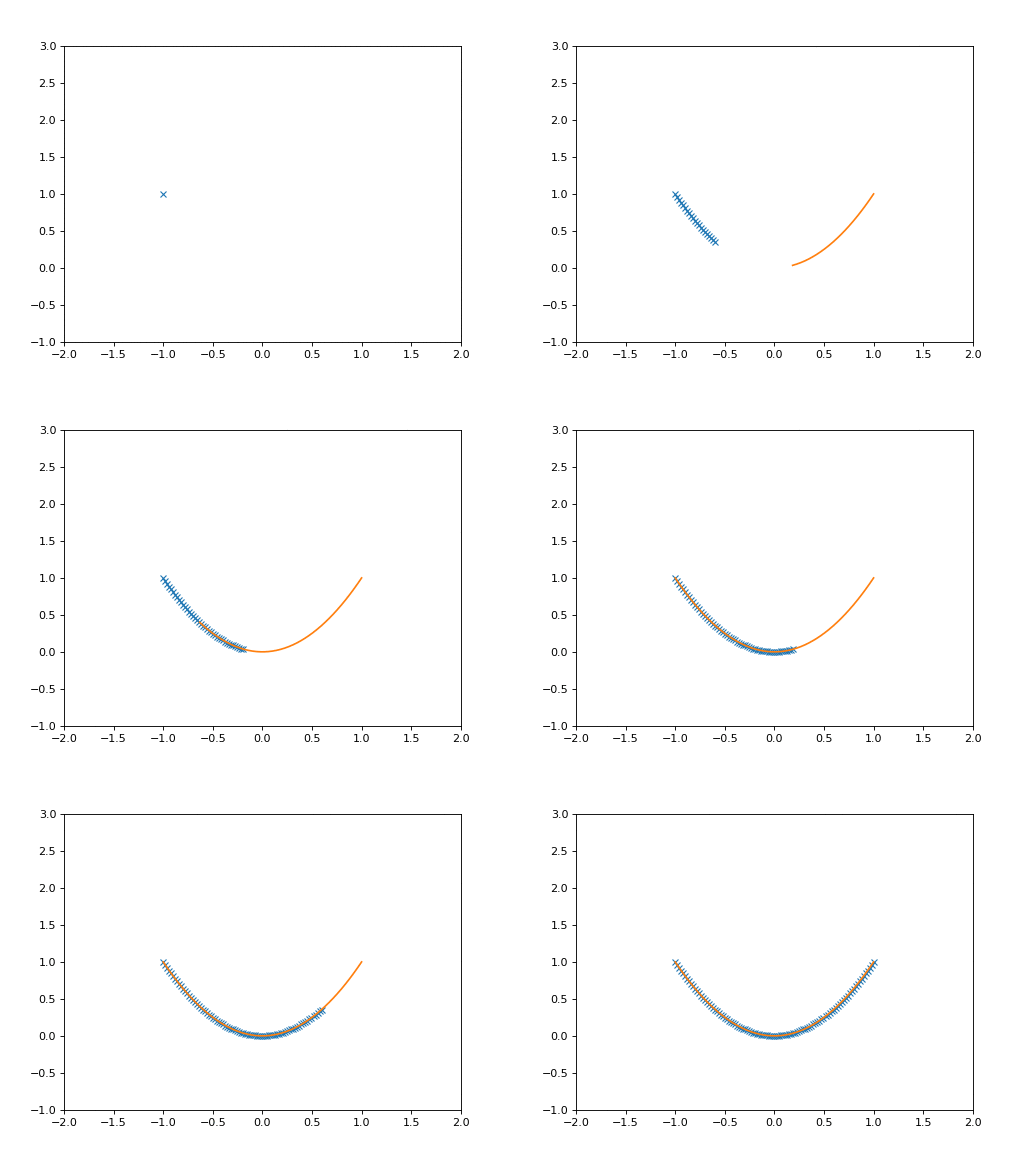
Notice that we have exactly the same ordered pairs $(x,y)$, even though the $t$ values we plugged in were different. This means they have exactly the same shape: the parabola $y = x^2$. However, unlike the graph of $y=x^2$, which only has shape information, these parametrically defined curves contain more information.
Speed and orientation
Let's treat $t$ as a time variable. Notice that $A$ gets from (-1,1) to (1,1) over the interval $-1 \leq t \leq 1$. Call that 2 seconds. But, $B$ gets from (-1,1) to (1,1) over the interval $-1/2 \leq t \leq 1/2$. So, that would be 1 second - i.e. half the time. Here's an animation ($A$ is in blue; $B$ is in orange).
Parametric Parabolas
We can repeat with circles to see how we can get different orientations.
Examples
Consider the following parametric equations:
$$ C_1: \begin{cases} x(t) = \cos{ t } \cr y(t) = \sin{ t } \end{cases} $$
$$ C_2: \begin{cases} x(t) = -\cos{ 2t }\cr y(t) = \sin{ 2t } \end{cases} $$
Both $C_1$ and $C_2$ represent circles. How do we know?
For $C_1$, $x^2 + y^2 = \cos^2 t + \sin^2 t = 1$. So $x^2 + y^2 = 1$, which is the unit circle.
Likewise, for $C_2$, $x^2 + y^2 = \cos^2 2t + \sin^2 2t = 1$. So, again, $x^2 + y^2 = 1$.
However, while the shape is the same, $C_2$ moves around the circle twice as fast and in the opposite direction (clockwise). Plug in some values for $t$ to see that this is the case.

Notice that the blue circle is being drawn counterclockwise while the orange one is being drawn clockwise and completes a full period twice as fast.
Eliminating the parameter
What do we do if we encounter a new set parametric equations and want to know what the corresponding curve looks like? Of course, we could just plot a bunch of points and connect the dots. Another option is to eliminate the parameter. In other words, we can express the relationship between $x$ and $y$ independent of $t$.
Example
Consider the equations below.
$$ \begin{cases} x(t) = t - 5\cr y(t) = \sqrt{t}\cr 0\leq t \leq 9 \end{cases} $$
Let's solve for $t$ in the $x$-equation:
$$ x = t - 5 \Longrightarrow t = x + 5 $$
Now, plug that into $y$:
$$ y = \sqrt{ x + 5 } $$
Now we know what the shape of the curve is. We also know that the curve begins at $( x(0), y(0) ) = $( -5, 0 )$ and ends at $( x(9), y(9) ) = ( 4, 3 )$.

Example
When trig functions are involved, we have to be a little more clever in eliminating the variable. For example, consider the following:
$$ \begin{cases} x(t) = \sin{ t }\cr y(t) = \cos{ 2t }\cr -\pi / 2 \leq t \leq \pi / 2 \end{cases} $$
Rather than solving for $t$ like we did before, let's use some trig identities. In particular, we can rewrite
$$ \cos{ 2t } = 1 - 2 \sin^2 { t } $$
Since $x = \sin t$, we have $y = 1 - 2x^2$. So this is an upside down parabola starting at $( x(-\pi/2), y(\pi/2) ) = ( -1 , -1 )$ and ends at $( x( \pi / 2 ), y( \pi / 2 ) ) = ( 1 , -1 )$.

Doing calculus with parametric equations
Much of the calculus we already know how to do is pretty easy to port over to parametrically defined curves. Let's start with some calc 1 material.
Tangents
We learned in calculus 1 that for a curve given by $y = f(x)$, the slope of the tangent line at $x = x_0$ is given by $\frac{ dy }{ dx } \biggr \rvert_{ x_0 }$ (i.e. the derivative evaluated at the point). Well, now we have this extra parameter, $t$, that we use to define $x$ and $y$. Fortunately, it's not too difficult to reinterpret $dy/dx$ in terms of $t$.
Let's apply $\frac{dt}{dt}$ to $\frac{dy}{dx}$:
$$ \frac{ dy }{ dx }\frac{ dt }{ dt } = \frac{ dy }{ dx }\frac{ \frac{ 1 }{ dt } }{ \frac{ 1 }{ dt } } = \frac{ \frac{ dy }{ dt }}{ \frac{ dx }{ dt } } $$
This should make intuitive sense - slope is change in $y$ over change in $x$, and that's exactly what this new expression is doing.
Example
Consider the curve defined by
$$ \begin{cases} x( t ) = 2 \cos t \cr y( t ) = 3 \sin t \end{cases} $$
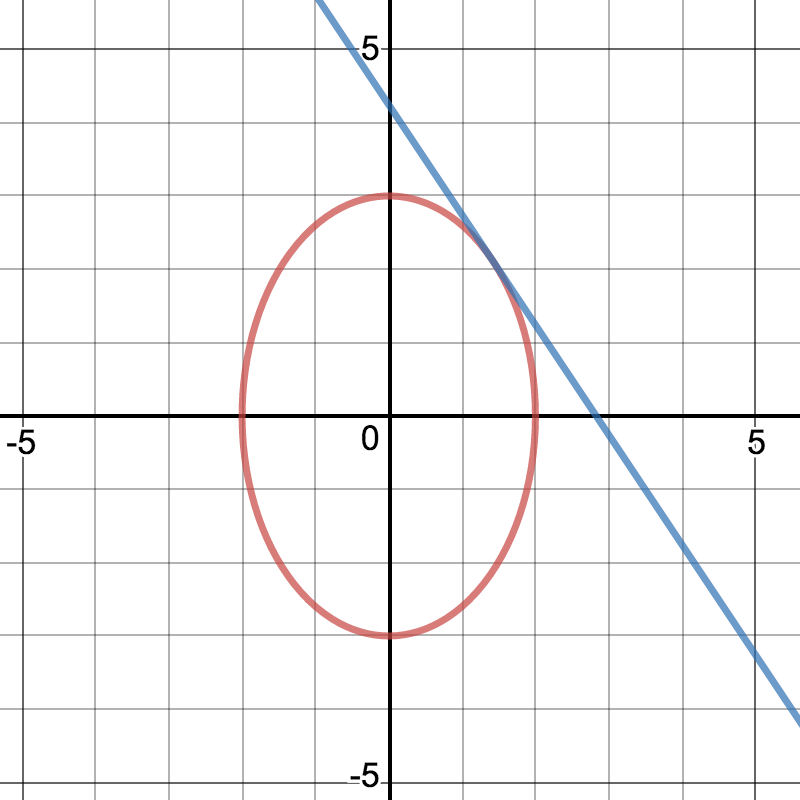
Let's find the slope of the line tangent to this curve when $t = \pi / 4$.
First, we find $\frac{ dy }{ dt }$ and $\frac{ dx }{ dt }$.
$$ \frac{ dx }{ dt } = -2 \sin t $$
$$ \frac{ dy }{ dt } = 3 \cos t $$
Putting these together we get
$$ \frac{ dy }{ dx } = \frac{ \frac{ dy }{ dt }}{ \frac{ dx }{ dt } } = - \frac{ 3 \cos t }{ 2 \sin t } $$
Evaluate at $t = \pi / 4$:
$$ \frac{ dy }{ dx } \biggr\rvert_{\pi/4} = - \frac{ 3 ( 1 / \sqrt{ 2 })}{ 2 ( 1 / \sqrt{ 2 } )} = - \frac{ 3 }{ 2 } $$
Tangent to Ellipse
Second Derivatives
Evaluating the second derivative, $\displaystyle\frac{d^2y}{dx^2}$ is a little bit trickier. So far we have that
$$ \frac{ dy }{ dx } = \frac{ \frac{ dy }{ dt }}{ \frac{ dx }{ dt } } $$
Once we have that, we can differentiate with respect to $x$ again to get the second derivative.
$$ \frac{d^2y}{dx^2} = \frac{ d }{ dx } \frac{ dy }{ dx } = \frac{ \frac{d}{dt} \frac{ dy }{ dx } }{ \frac{dx}{dt} } $$
So in summary: we differentiate $dy/dx$ with respect to $t$ again and then divide by $dx/dt$.
Example
Consider the parametric curve given by
$$ \begin{cases} x( t ) = \sin( 3t ) \cr y( t ) = 2 \cos( 3t ) \end{cases}$$
First, we find $\frac{ dy }{ dt }$ and $\frac{ dx }{ dt }$.
$$ \frac{ dx }{ dt } = 3 \cos( 3t ) $$
$$ \frac{ dy }{ dt } = - 6 \sin( 3t ) $$
So
$$ \frac{ dy }{ dx } = \frac{ -6 \sin( 3t ) }{ 3 \cos( 3t ) } = \frac{ -2 \sin( 3t ) }{ \cos( 3t ) } = -2 \tan( 3t ) $$
Now we differentiate that with respect to $t$:
$$ \frac{ d }{ dt }\frac{ dy }{ dx } = -2\sec^2( 3t ) $$
Finally, we have
$$\frac{d^2y}{dx^2} = \frac{ \frac{d}{dt} \frac{ dy }{ dx } }{ \frac{dx}{dt} } = \frac{ -2 \sec^2( 3t ) }{ 3\cos( 3t ) } = \boxed{ - \frac{ 2 }{ 3 } \sec^3( 3t) }$$
Arc length
When we derived the arc length formula originally, we started with the pythagorean theorem (the distance formula) applied to an infinitesimally small secant line:
$$ dL = \sqrt{ dx^2 + dy^2 } $$
We want to integrate in terms of $t$, so we multiply by $dt/dt$.
$$ dL = \sqrt{ dx^2 + dy^2 }\frac{ dt }{ dt } = \sqrt{ \frac{ 1 }{ dt^2 }( dx^2 + dy^2 ) } \ dt = \sqrt{ \left( \frac{dx}{dt} \right)^2 + \left( \frac{dy}{dt} \right)^2}\ dt $$
Integrating both sides we get
$$L = \int_{a}^{b} \sqrt{ \left( \frac{dx}{dt} \right)^2 + \left( \frac{dy}{dt} \right)^2}\ dt $$
Example
Let's find the arc length of the curve defined by
$$ \begin{cases} x(t) = \frac12 t^2\cr y(t) = \frac13 t^3\cr 0 \leq t \leq \sqrt3 \end{cases} $$
First, let's find the derivatives:
$$ \frac{dx}{dt} = t $$
$$ \frac{dy}{dt} = t^2 $$
Before plugging in, let's square the derivatives:
$$ \left(\frac{dx}{dt}\right)^2 = t^2 \quad \left(\frac{dy}{dt}\right)^2 = t^4 $$
For the arc length we have
$$ L = \int_0^{\sqrt3} \sqrt{t^2 + t^4} \ dt = \int_0^{\sqrt3} \sqrt{t^2(1 + t^2)} \ dt = \int_0^{\sqrt3} t\sqrt{(1 + t^2)} \ dt $$
Let $u = 1 + t^2$. Then $du = 2t\ dt$. When $t = 0$, $u = 1$ and when $t = \sqrt{3}$, $u = 4$.
$$ L = \frac12\int_1^4 \sqrt{u} \ du = \frac12 \cdot \frac23 u^{3/2} \biggr\rvert_1^4 = \frac13 (8 - 1) = \boxed{7/3} $$