Analysis of Functions
In this section, we are going to explore, in greater depth, what the first and second derivatives tell us about a function. In other words, we’ll use $f’$ and $f’’$ to analyze the behavior of $f$. The short answer is that $f’$ tells us where $f$ is increasing and decreasing, while $f’’$ tells us where $f$ is concave up and concave down. These concepts pave the way to optimization - determining where a function has peaks and valleys, maxima and minima.
Increasing/Decreasing
What do we mean when we say that $f$ is increasing? It might seem like a silly question with a really obvious answer. But the question is really asking whether we can express our intuition in a mathematically
Looking Back at the Definition of the Derivative
Recall that to compute the instantaneous rate of change of $f$ at $x = a$, we evaluate the following limit:
$$ f’(a) = \lim_{b \to a} \frac{f(b) - f(a)}{b - a} $$
Increasing and Decreasing
What does it mean for a function to be increasing?
Solution
What does it mean for a function to be decreasing?
Solution
So, what can we say about the derivative of $f$ when $f$ is increasing?
Solution
What if $f$ is decreasing?
Solution
We conclude that…
- If $f’ >0$, $f$ is increasing
- If $f’ <0$, $f$ is decreasing
Concavity
The relationship between $f$ and $f’$ is the same as the relationship between $f’$ and $f’’$. So…
- $f’’ > 0 \Longrightarrow f’ \text{ is increasing }$
- $f’’ < 0\Longrightarrow f’ \text{ is decreasing }$
Now the question is, “what does it mean when the slopes of the tangent lines to a curve are increasing/decreasing?”
If the slopes of the tangent lines to a curve are increasing, we get something like this:
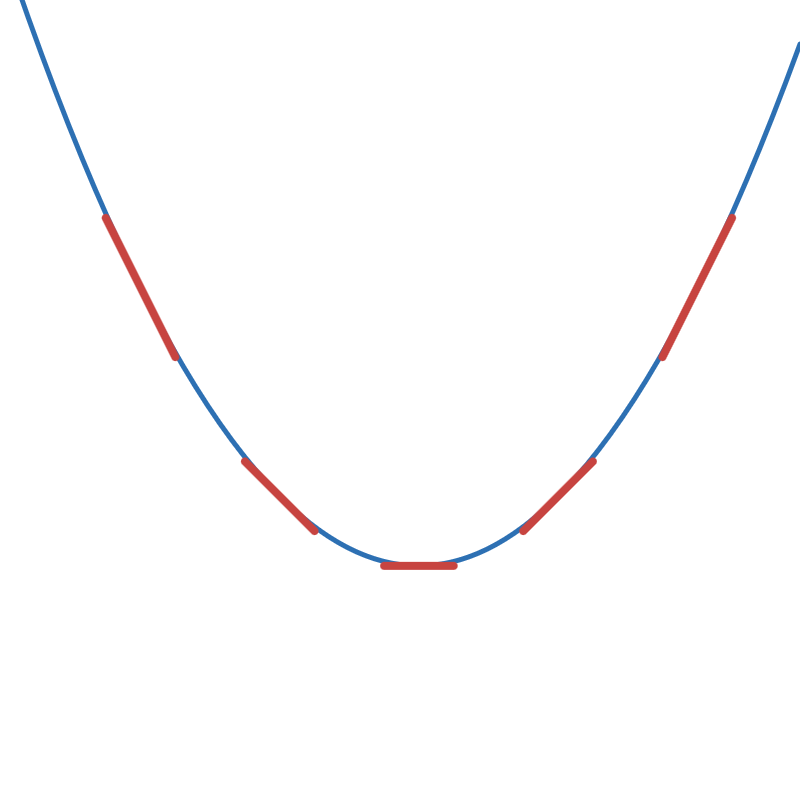
We call this kind of shape concave up.
If the slopes of the tangent lines to a curve are decreasing, we get something like this:
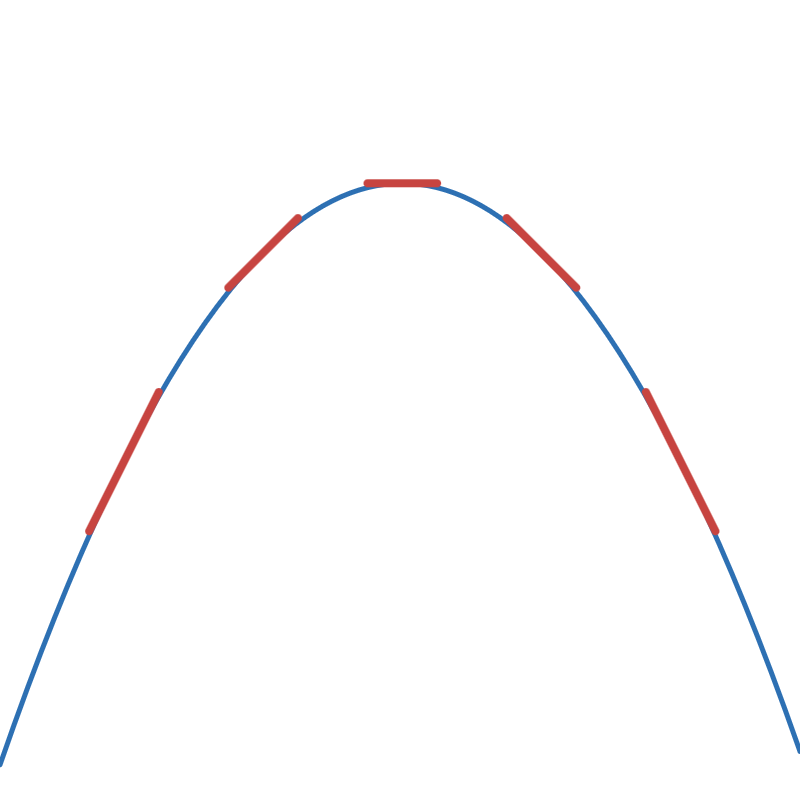
We call this kind of shape concave down.
Putting it all together:
What $f’$ and $f’’$ tell us about f
- $f’ > 0 \Longrightarrow f \text{ is increasing}$
- $f’ < 0 \Longrightarrow f \text{ is decreasing}$
- $f’’ > 0 \Longrightarrow f \text{ is concave up}$
- $f’’ < 0 \Longrightarrow f \text{ is concave down}$
Example
Let’s consider the function $f(x) = \frac13 x^3 - x^2 - 3x + 1$.
We’ll begin by finding the intervals on which $f$ is increasing and decreasing. To do that, we need to determine where $f’$ is positive and where it’s negative. One good way to do that is to make a sign chart.
- First, compute $f’$:
$$f’(x) = x^2 - 2x - 3$$
- Next, identify points where $f’$ can change sign.
$$ \begin{aligned} x^2 - 2x - 3 &= 0 \cr (x - 3)(x+1) &= 0 \cr x &= -1,3 \end{aligned} $$
- Now, we can make a sign chart:
| + + + | 0 | - - - | 0 | + + + |
|---|---|---|---|---|
| -2 | -1 | 0 | 3 | 4 |
- Now, we can draw our conclusions:
- $f$ is increasing on $(-\infty, -1)$ and $(3, \infty)$
- $f$ is decreasing on $(-1,3)$
Next, let’s find the intervals where $f$ is concave up and concave down.
- Compute $f’’$:
$$f’’(x) = 2x - 2$$
- Determine where $f’’$ could change sign:
$$ \begin{aligned} 2x - 2 &= 0 \cr x &= 1 \end{aligned} $$
- Make a sign chart:
| - - - | 0 | + + + |
|---|---|---|
| 0 | 1 | 2 |
- We can conclude…
- $f$ is concave up on $(1, \infty)$
- $f$ is concave down on $(-\infty, 1)$
Let’s take a look at the graph of $f$ and see how our conclusions map onto it.
Notice where $f$ is increasing (blue) and decreasing (red):
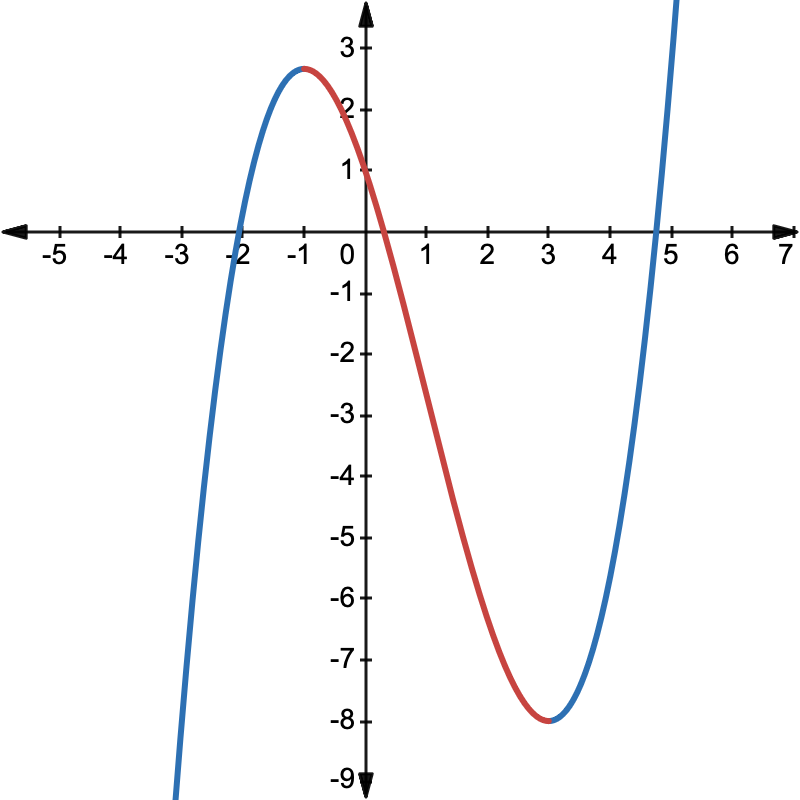
Notice where $f$ is concave up (green) and concave down (purple):
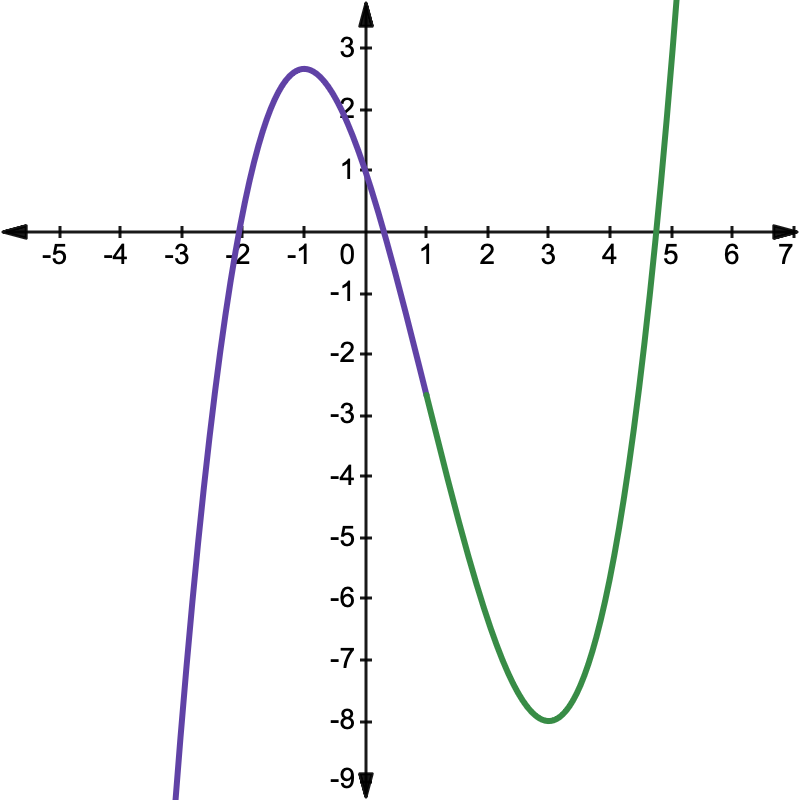
There are several important points on these graphs:
- $\left(-1, \frac{8}{3}\right)$ is a relative maximum: a point where a function goes from increasing to decreasing.
- $(3, -8)$ is a relative minimum: a point where a function goes from decreasing to increasing.
- $\left(1, -\frac{8}{3}\right)$ is an inflection point: a point where a function changes concavity.
Our Process
- Compute $f'$
- Find critical points:
- Set $f’(x) = 0$ and solve
- Determine if there are any points where $f’$ is undefined
- Make a sign chart for $f’$ using the points found in step (2)
- Draw conclusions from sign chart for $f’$:
- $f’>0$: $f$ is increasing
- $f’<0$: $f$ is decreasing
- $f’$ changes from $(+)$ to $(-)$: $f$ has a relative maximum
- $f’$ changes from $(-)$ to $(+)$: $f$ has a relative minimum
- Compute $f’'$
- Find points where $f’’$ might change sign
- Set $f’’(x) = 0$ and solve
- Determine if there are any points where $f’’$ is undefined
- Make a sign chart for $f’'$
- Draw conclusions from sign chart for $f’’$:
- $f’’>0$: $f$ is concave up
- $f’’<0$: $f$ is concave down
- $f’’$ changes from sign: $f$ has an inflection point
Example
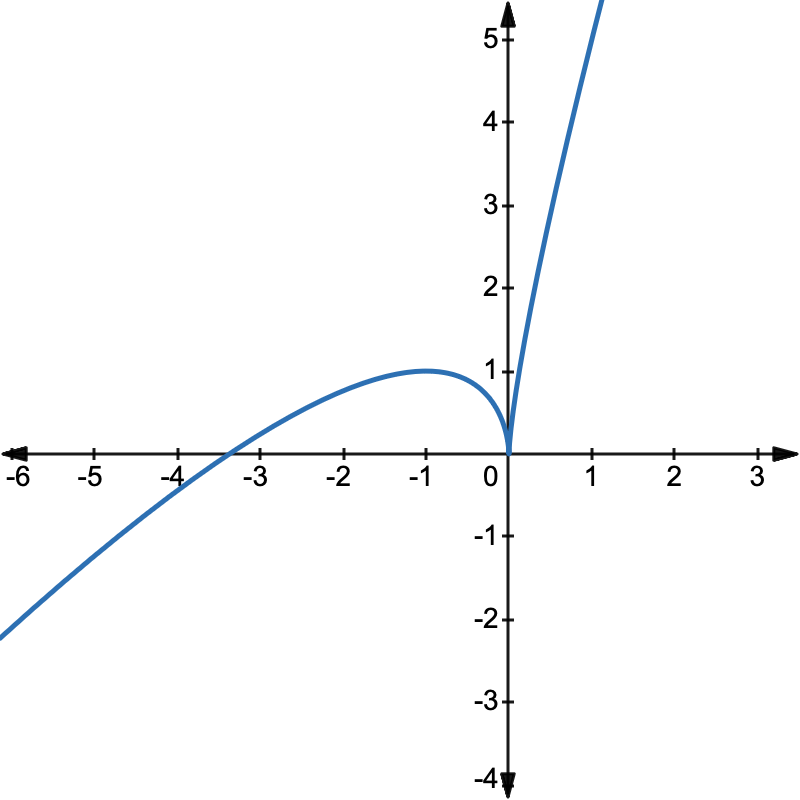
Let’s try our process out with another function:
$$f(x) = 2x + 3x^{3/2}$$
- Compute $f’$:
$$f’(x) = 2 + 2x^{-1/3}$$
- Find critical points:
- Set $f’(x) = 0$ and solve
$$ \begin{aligned} 2 + 2x^{-1/3} &= 0 \cr x^{-1/3} &= -1 \cr x &= -1 \end{aligned} $$
- Determine if there are any points where $f’$ is undefined
$$f’(x) = 2 + 2x^{-1/3} = 2 + \frac{2}{\sqrt[3]{x}} \text{ is undefined at } x=0$$
- Make a sign chart for $f’$ using the points found in step (2)
| + + + | 0 | - - - | UND | + + + |
|---|---|---|---|---|
| -8 | -1 | -1/8 | 0 | 1 |
- Draw conclusions from sign chart for $f’$:
- $f$ is increasing on $(-\infty, -1)$ and $(0, \infty)$
- $f$ is decreasing on $(-1, 0)$
- $f$ has a relative maximum at $(-1,1)$
- $f$ has a relative minimum at $(0,0)$
- Compute $f’'$
$$f’’(x) = -\frac{2}{3} x^{-4/3}$$
-
Find points where $f’’$ might change sign
- Set $f’’(x) = 0$ and solve
$$-\frac{2}{3} x^{-4/3} = -\frac{2}{3\sqrt[3]{x^4}} = 0 \text{ has no solutions}$$
- Determine if there are any points where $f’’$ is undefined
$$-\frac{2}{3\sqrt[3]{x^4}} \text{ is undefined at } x = 0$$
- Make a sign chart for $f’'$
| - - - | UND | - - - |
|---|---|---|
| -1 | 0 | 1 |
- Draw conclusions from sign chart for $f’’$:
- $f$ is never concave up
- $f$ is concave down on $(-\infty, 0)$ and $(0, \infty)$
- $f$ has no inflection points
Here’s the graph of $f$:
Exercise
Repeat our process for $f(x) = x^4 - 2x^2$.
Solution
Let’s consolidate our work a little. First, find the first and second derivatives and then determine where each can change sign.
$$ \begin{aligned} f(x) &= x^4 - 2x^2 \cr f’(x) &= 4x^3 - 4x \cr 4x^3 - 4x &= 0 & {\text{ set $f’ = 0$ }} \cr 2x(x^2 - 1) &= 0 \cr x &= \boxed{0, \pm 1} \cr f’’(x) &= 12x^2 - 4 \cr 12x^2 - 4 &= 0 & {\text{ set $f’’ = 0$ }} \cr 4(3x^2 - 1) &= 0 \cr x &= \boxed{\pm \frac{1}{\sqrt{3}}} \end{aligned} $$
Now we’ll make both sign charts:
| $f'$ | - - - | 0 | + + + | 0 | - - - | 0 | + + + |
|---|---|---|---|---|---|---|---|
| $x$ | -2 | -1 | -1/2 | 0 | 1/2 | 1 | 2 |
| $f’'$ | + + + | 0 | - - - | 0 | + + + |
|---|---|---|---|---|---|
| $x$ | -1 | $-1/\sqrt3$ | 0 | $1/\sqrt3$ | 1 |
Conclusions:
- $f$ is increasing on $(-1, 0)$ and $(1, \infty)$
- $f$ is decreasing on $(-\infty, -1)$ and $(0,1)$
- $f$ has a relative maximum at $x = 0$
- $f$ has a relative minimum at $x = -1$ and $x = 1$
- $f$ is concave up on $(-\infty, -1/\sqrt3)$ and $(1/\sqrt3, \infty)$
- $f$ is concave down on $(-1/\sqrt3, 1/\sqrt3)$
- $f$ has an inflection point at $x = \pm 1/\sqrt3$