Related Rates
In most related rates problems, we have an equation that relates a bunch of quantities that are changing over time. For example, suppose we have a right triangle whose base and height are getting longer. Let’s say the base is getting longer at a rate of 3 in/sec and the height is getting longer at a rate of 4 in/sec.
Applying Implicit Differentiation
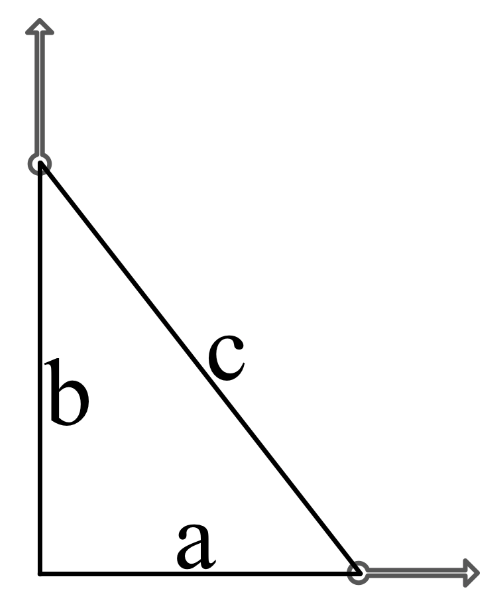
If the base and height start from 0 in, then after 3 seconds, $a=9$ and $b=12$. Using the pythagorean theorem, we get that $c=15$.
Suppose I want to know how fast the area of the triangle is growing at that moment. The formula for area is $A=\frac{1}{2}ab$. Since $A$, $a$, and $b$ are all growing over time, we can take the derivative of both sides with respect to $t$ (implicit differentiation).
$$\begin{aligned} A&=\frac{1}{2}ab\cr \frac{dA}{d t}&=\frac{1}{2}\frac{da}{d t}b + \frac{1}{2}a\frac{db}{d t}\end{aligned}$$
Notice that we used the product rule on the right hand side and treated each letter as a function of $t$.
What do $\frac{dA}{d t}$, $\frac{da}{d t}$, and $\frac{db}{d t}$ represent?
They are the rates of change of $A$, $a$, and $b$, respectively. So, $\frac{da}{d t} = 3$ and $\frac{db}{d t} = 4$ because we said that these sides are growing at those rates. $\frac{dA}{d t}$ is the rate of change of the area with respect to time. This is what we want to know.
We can find how fast the area is growing at 3 seconds by plugging everything into that differentiated equation:
$$\begin{aligned} \frac{dA}{d t}&=\frac{1}{2}\frac{da}{d t}b + \frac{1}{2}a\frac{db}{d t}\cr & = \frac{1}{2}(3)(12) + \frac{1}{2}(9)(4)\cr & = \boxed{36 \text{ in}^2/\text{sec}}\end{aligned}$$
Example: Oil Spill
Oil spilled from a ruptured tanker spreads in a circle whose area increases at a constant rate of 6 mi$^2$/hr. How fast is the radius of the spill increasing when the area is 9 mi$^2$?
The following steps are intended to provide a framework for solving these types of problems. You do not have to work through these problems in exactly the same order, but having a systematic approach that works for you is very important.
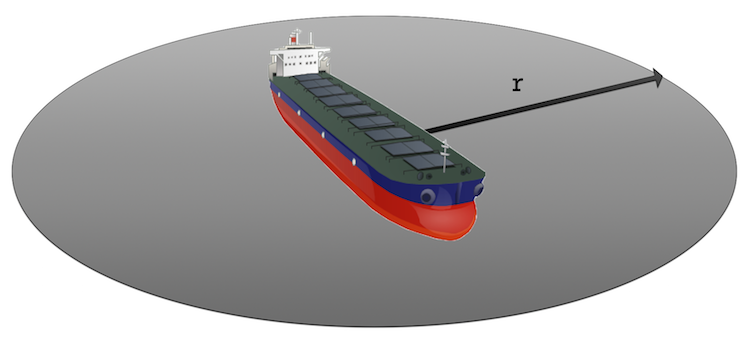
STEP 1: Start by drawing a picture.
STEP 2: Variables
We have two quantities varying here: area and radius. Let $r$ be the radius of the spill and $A$ be the area of the spill.
STEP 3: Phrasing the given information and the question in term of the variables We are told that the area increases at a constant rate of 6mi$^2$/hr. This is a change in area/change in time $\to \frac{dA}{d t}$. So, we have $\frac{dA}{d t} = 6$.
We are asked “How fast is the radius of the spill increasing when the area is 9 mi$^2$?” This can be rephrased with our variable and their derivatives as “What is $\frac{d r}{d t}$ when $A= 9$mi$^2$?”
STEP 4: Relevant formulas
What are the relevant formulas?
Since we’re dealing with a circle, there are only two options: $A=\pi r^2$ and $C=2\pi r$. Since there’s no mention of circumference, we can disregard the latter formula.
STEP 5: Differentiate and solve
$$\begin{aligned} A&=\pi r^2\cr \frac{dA}{d t} &= \pi (2r) \frac{d r}{d t}\end{aligned}$$
Notice that in order to solve for $\frac{d r}{d t}$ we need to plug in $\frac{dA}{d t}$ and $r$. $\frac{dA}{d t}$ is given, but we still need $r$.
Find $r$ when $A = 9$.
$$\begin{aligned} A&=\pi r^2\cr 9&=\pi r^2\cr \frac{9}{\pi}&=r^2\cr r &= \frac{3}{\sqrt{\pi}}\end{aligned}$$
And now, finally, we can solve:
$$\begin{aligned} \frac{dA}{d t} &= \pi (2r) \frac{d r}{d t}\cr 6 &= \pi (2)\left(\frac{3}{\sqrt{\pi}}\right)\left(\frac{d r}{d t}\right)\cr 6 &= 6\sqrt{\pi}\frac{d r}{d t}\cr \frac{d r}{d t} &= \frac{6}{6\sqrt{\pi}}\cr &=\boxed{\frac{1}{\sqrt{\pi}} \text{ mi/hr}}\end{aligned}$$
Example: Softball Diamond
A softball diamond is a square whose sides are 60 ft long. Suppose that a player running from first to second base has a speed of 25 ft/s at the instant when she is 10 ft from second base. At what rate is the players distance from home plate changing at that instant?
Draw a picture and label variables
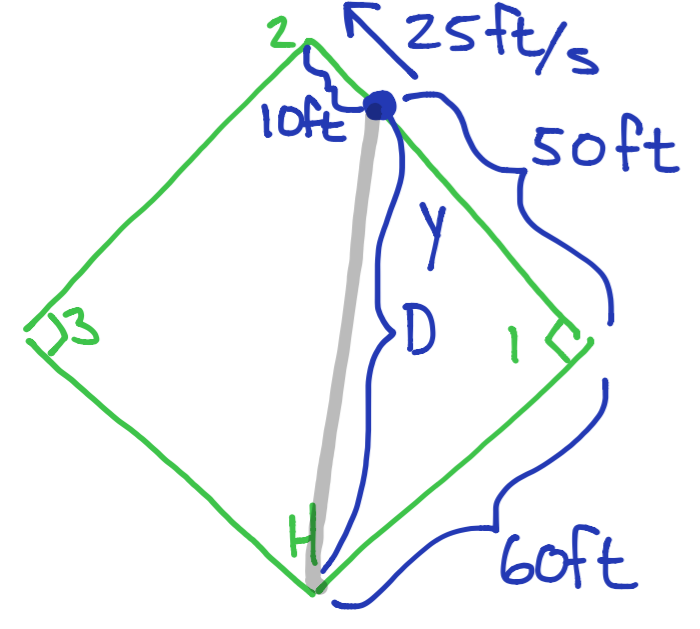
I’ve called the distance from the origin $D$ and the distance between the player and first base $y$. The distance between home and first doesn’t need a name since it isn’t changing. Rephrasing We are told that $\frac{d y}{d t} = 25$.
We want to find $\frac{dD}{d t}$ when $y=50$.
Relevant formulas
We have a right triangle. Since there’s no mention of angle, lets use the pythagorean theorem: $60^2 + y^2 = D^2$.
Differentiate and solve
$$ \begin{aligned} 60^2 + y^2 &= D^2\cr 2y\frac{d y}{d t} &= 2D\frac{dD}{d t} \end{aligned} $$
We’ll need $D$ when $y=50$. So we plug into the original equation:
$$60^2 + (50)^2 = D^2$$
$$D = \sqrt{6100} = 10\sqrt{61}$$
Now, we plug everything into the differentiated formula:
$$2(50)(25) = 2\sqrt{6100}\frac{dD}{d t}$$
$$\frac{dD}{d t} = \frac{1250}{10\sqrt{61}} = \frac{125}{\sqrt{61}}$$
Exercise: Spherical Baloon
Air is being pumped into a spherical balloon at a rate of 7 cubic centimeters per second. What is the rate of change of the radius at the instant the volume is 36$\pi$? The volume of a sphere of radius $r$ is $\frac{4\pi}{3}r^3$.
Solution
Let’s differentiate first (remember to treat each variable as a function of $t$):
$$V = \frac{4}{3}\pi r^3 \Longrightarrow \text{ implicit differentiation } \Longrightarrow \frac{dV}{d t} = 4\pi r^2\frac{d r}{d t}$$
We need to find $\frac{d r}{d t}$ at the instant when $V=36\pi$. We already know that $\frac{dV}{d t} = 7$ from the problem statement (that’s the rate of change of the volume). But we also need to plug in for $r$. To find the value of $r$ at the instant when $V=36\pi$, we can use the original volume formula.
$$\begin{aligned} V &= \frac{4}{3}\pi r^3\cr 36\pi &= \frac{4}{3}\pi r^3\cr r &= 3 \end{aligned}$$
Now we plug everything in and solve:
$$\begin{aligned} \frac{dV}{d t} &= 4\pi r^2\frac{d r}{d t}\cr 7 &= 4\pi (3)^2\frac{d r}{d t}\cr \frac{d r}{d t} &= \boxed{\frac{7}{36\pi}\text{ cm}^3/\text{sec}} \end{aligned}$$
Exercise: Sliding Ladder
A young woman and her boyfriend plan to elope, but she must first rescue him from his mother who has locked him in his room. The young woman has placed a 20 foot long ladder against his house and is knocking on his window when his mother starts pulling the bottom of the ladder away from the house at a constant rate of 3 feet per second. How fast is the top of the ladder (and the young couple) falling when the bottom of the ladder is 12 feet from the bottom of the wall?
Solution
We’ll use the following variables:
-
$x$: the distance from the bottom of the ladder to the wall
-
$y$: the distance from the top of the ladder to the ground
We’re given $\frac{dx}{d t} = 3$. We want to find $\frac{d y}{d t}$ when $x=12$.
Let’s first differentiate $x^2 + y^2 = 20^2$ with respect to $t$:
$$2x\frac{dx}{d t} + 2y\frac{d y}{d t} = 0$$
We already know what to plug in for $x$ and $\frac{dx}{d t}$ ,but we also need to plug in for $y$. When $x=12$ we have:
$$12^2 + y^2 = 20^2$$
$$y=16$$
Finally, we have:
$$2(12)(3) + 2(16)\frac{d y}{d t} = 0$$ $$\frac{d y}{d t} = \boxed{-\frac{9}{4} ft/sec}$$
Exercise: Conical Tank
A conical water tank has a height of 20 ft and a radius of 10 ft at the top. If water is being poured into the tank at a rate of 10 ft$^3$/min, how quickly is the depth of the water increasing when the water is 8 ft deep? when the water is 12 ft deep?
Solution
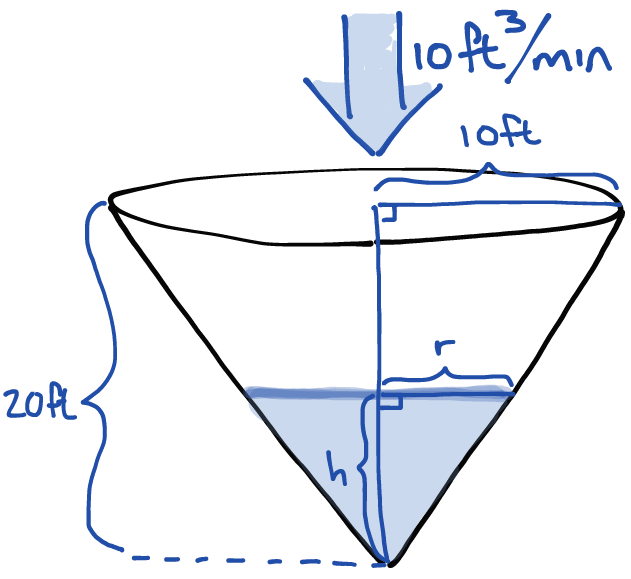
In this problem, the first thing we want to do is simplify the volume formula so that it depends only on the height. Notice that, because the liquid in the tank takes the shape of the conical tank, they must be similar cones. Just like similar triangles, they must be proportional.
$$\frac{r}{h} = \frac{10}{20} \Longrightarrow r=\frac{1}{2}h$$
Now, we can rewrite the formula for volume. $V=\frac{1}{3}\pi r^2h$ becomes $$V=\frac{1}{3}\pi\left(\frac{1}{2}h\right)^2h \Longrightarrow \text{ simplify } \Longrightarrow V=\frac{1}{12}\pi h^3$$
Now, when we differentiate, we don’t have to use the product rule.
$$\frac{dV}{d t} = \frac{1}{12}\pi (3h^2)\frac{dh}{d t} \Longrightarrow \text{ simplify } \Longrightarrow \frac{dV}{d t} = \frac{1}{4}\pi h^2\frac{dh}{d t}$$
We know $\frac{dV}{d t} = 10$ and want $\frac{dh}{d t}$ when $h=8$, so we have
$$10 = \frac{1}{4}\pi(8)^2\frac{dh}{d t} \text{ simplify } \Longrightarrow \frac{dh}{d t} = \boxed{\frac{5}{8\pi}ft/min}$$
If we want $\frac{dh}{d t}$ when $h=12$, we get
$$10 = \frac{1}{4}\pi(12)^2\frac{dh}{d t} \text{ simplify } \Longrightarrow \frac{dh}{d t} = \boxed{\frac{5}{18\pi}ft/min}$$
Exercise: Rocket Camera
A camera is mounted 4000 ft from the base of a rocket launching pad. If the rocket is rising vertically at 1000 ft/sec when it is 3000 ft above the launching pad, how fast must the camera elevation angle change at that instant to keep the rocket in sight? How fast is the camera-rocket distance changing at that same moment?
Solution
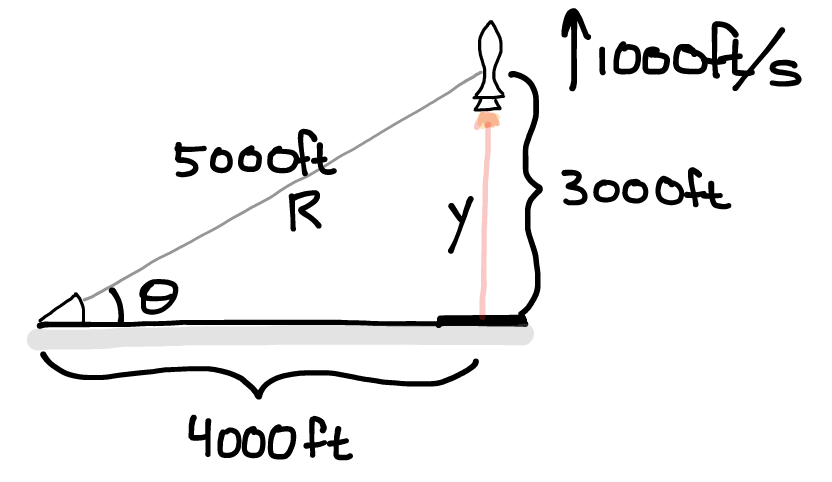
Let’s use $\tan{\theta} = \frac{y}{4000}$ to find the rate of change of the elevation angle (You could use any trig function, but this equation uses mostly stuff we know already).
$$\tan{\theta} = \frac{y}{4000} \Longrightarrow \text{ differentiate } \Longrightarrow \sec^2{\theta}\frac{d\theta}{d t} = \frac{1}{4000}\frac{d y}{d t}$$
We want $\frac{d\theta}{d t}$ and already know $\frac{d y}{d t}$. $\sec\theta$ can just be read from the triangle:
$$\sec\theta = \frac{hyp}{adj} = \frac{5000}{4000} = \frac54$$
So we have
$$\left(\frac54\right)^2\frac{d\theta}{d t} = \frac{1}{4000}(1000) \Longrightarrow \frac{d\theta}{d t} = \boxed{\frac{4}{25} rad/sec}$$
To find the camera-rocket distance, we can just use the Pythagorean theorem:
$$4000^2 + y^2 = R^2 \Longrightarrow \text{ differentiate } \Longrightarrow 2y\frac{d y}{d t} = 2R\frac{dR}{d t}$$
Plug in what we know:
$$2(3000)(1000) = 2(5000)\frac{dR}{d t}$$ $$\frac{dR}{d t} = \boxed{600 ft/sec}$$
Exercise: Street Light Shadow
A street light is mounted at the top of a 12 ft pole. A 4 ft child walks away from the pole at a speed of 3 ft/sec. How fast is the tip of her shadow moving?
Solution
Our setup looks like this:
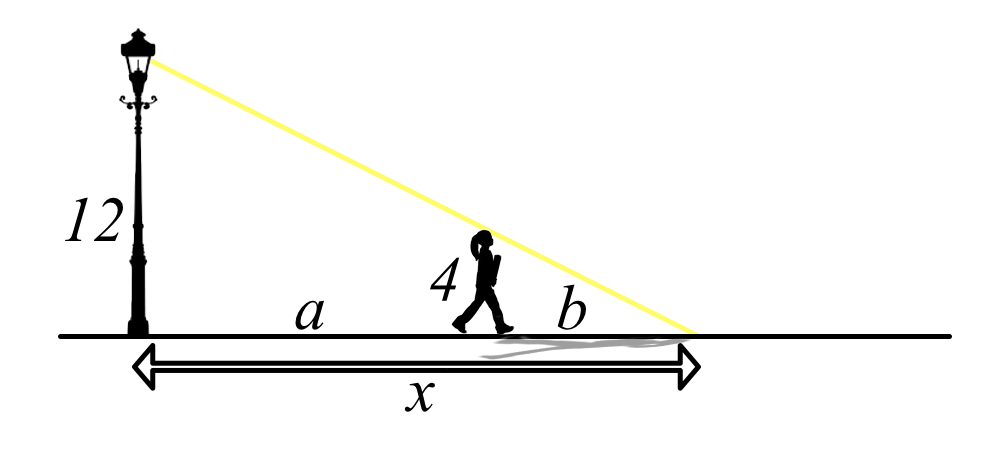
The rate at which her shadow is moving is $\frac{dx}{d t}$ - this is what we want to solve for.
Using similar triangles, we have $\frac{x}{12} = \frac{b}{4}$. Alternatively, we can write $\frac{a + b}{12} = \frac{b}{4}$
Simplifying that, we’re left with $a = 2b$. Differentiating both sides with respect to $t$ yields
$$\frac{da}{d t} = 2\frac{db}{d t}$$
Plugging in what we know, we get $3 = 2\frac{db}{d t}$ so $\frac{db}{d t} = \frac32$.
Since $x = a + b$, $$\frac{dx}{d t} = \frac{da}{d t} + \frac{db}{d t} = 3 + \frac32 = \boxed{9/2\text{ ft/sec}}$$