The Fundamental Theorem of Calculus
If The Fundamental Theorem of Calculus sounds like a big deal, that’s because it is! This theorem is going to do two important things for us: (1) It’s going to demonstrate the link between differential calculus and the area problem we’ve been working on in this chapter. (2) It’s going to provide us with a much more expedient way to compute net-signed area of a function.
Proof
The theorem comes in two parts. We’ll prove each with enough rigor to support our intuition, but we’ll leave out some
Part 1
Given a function $f$ and an interval $[a,b]$, on which $f$ is continuous, let’s define a somewhat strange function, $F$, as follows:
$$ F(x) = \int_a^x f(t)\ dt, \quad a\leq x\leq b $$
A couple things to clarify here:
- What $F$ does is compute the net-signed area for $f$ from $a$ to $x$. So it’s giving us part of the net signed area over $[a,b]$. In other words, $F$ gives us the area of $f$.
- We’re using $t$ as the variable inside the integral so as to not use $x$ in two different places.
What happens if we compute the derivative of $F$?
$$ \begin{aligned} F’(x) &= \lim_{h \to 0}\frac{F(x+h) - F(x)}{h}\cr &= \lim_{h \to 0}\frac{1}{h}\left(\int_{a}^{x+h} { f(t) } \ dt - \int_{a}^{x} { f(t) } \ dt\right)\cr &= \lim_{h \to 0}\frac{1}{h}\left(\int_{x}^{x+h} { f(t) } \ dt\right)\cr \end{aligned} $$
Here, we used a basic property of definite integrals to simplify $\int_{a}^{x+h} { f(t) } \ d t - \int_{a}^{x} { f(t) } \ d t$.
We have
$$ \int_{a}^{x+h} { f(t) } \ dt $$
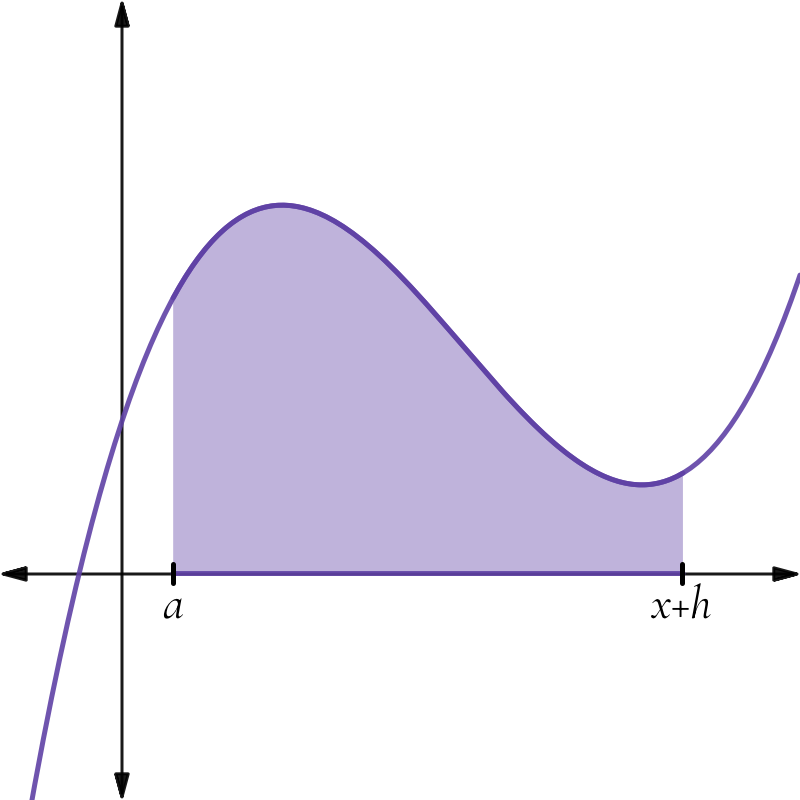
$$ \int_{a}^{x} { f(t) } \ dt $$
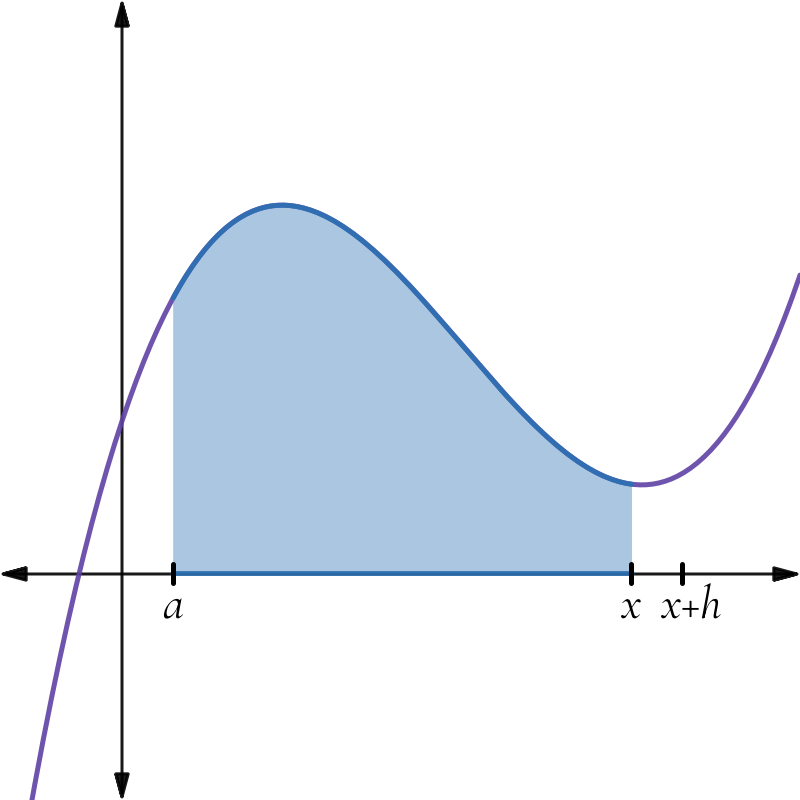
$$ \int_{x}^{x+h} { f(t) } \ dt = \int_{a}^{x+h} { f(t) } \ dt - \int_{a}^{x} { f(t) } \ dt $$
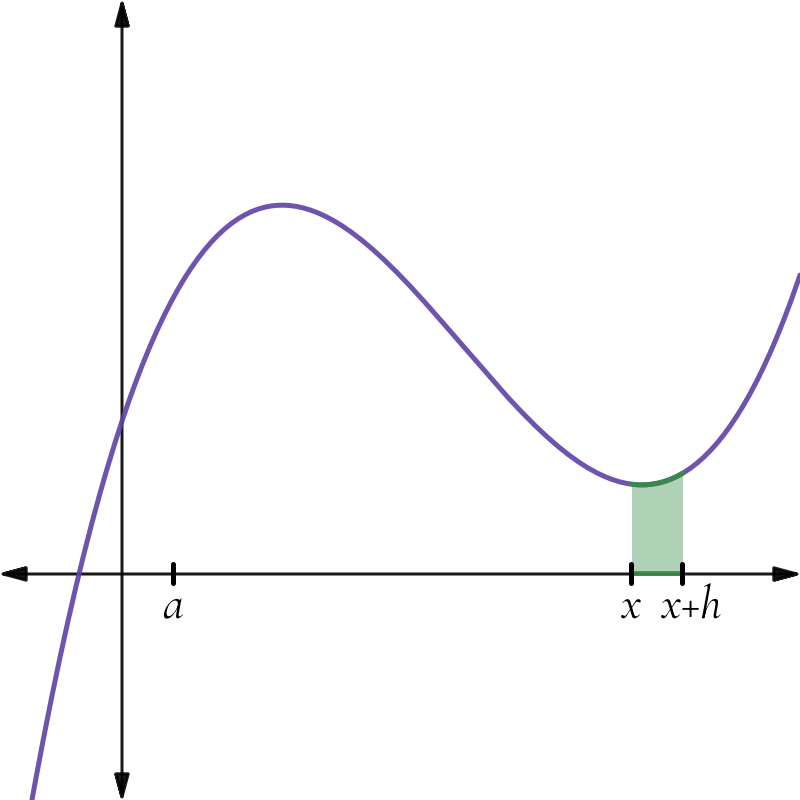
We’re left with this integral $\int_{x}^{x+h} { f(t) } \ d t$, which represents the net-signed area for $f$ over $[x,x+h]$. Since $f$ is assumed to be continuous, the extreme value theorem tells us that $f$ must have a maximum value and a minimum value on $[x,x+h]$. Let’s call these $M_h$ and $m_h$, respectively.
Because both $M_h$ and $m_h$ are constants, we have
$$ \int_{x}^{x+h} { M_h } \ dt = hM_h \quad \text{and} \quad \int_{x}^{x+h} { m_h } \ dt = hm_h $$
As $h\to 0$, the interval $[x,x+h]$ shrinks. As that happens,the maximum and minimum values of $f$ must be getting closer to $f(x)$: $m_h \to f(x)$ and $M_h \to f(x)$.
We can also say that
$$ \begin{aligned} \int_{x}^{x+h} { m_h } \ dt \leq &\int_{x}^{x+h} { f(t) } \ dt \leq \int_{x}^{x+h} { M_h } \ dt\cr hm_h \ dt \leq &\int_{x}^{x+h} { f(t) } \ dt \leq hM_h\cr m_h \leq \frac{1}{h}&\int_{x}^{x+h} { f(t) } \ dt \leq M_h\cr \end{aligned} $$
By the Squeeze Theorem, since $\lim_{h \to 0}m_h = f(x)$ and $\lim_{h \to 0}M_h = f(x)$, it follows that
$$ \lim_{h \to 0}\frac{1}{h}\int_{x}^{x+h} { f(t) } \ dt = f(x) $$
We’ve now shown that $F’(x) = f(x)$. We say that $F$ is an antiderivative of $f$.
We can summarize Part 1 of the Fundamental Theorem of Calculus as follows:
$$ \frac{d}{dx}\left(\int_{a}^{x} { f(t) } \ dt\right) = f(x) $$
This is saying that integration and differentiation are inverse operations.
On to Part 2…
Part 2
Define
$$G(x) = \int_{a}^{x} { F’(t) } \ dt$$
According to Part 1, we have $G’(x) = F’(x)$. Since the derivative of a constant is zero, we know that $G(x)$ and $F(x)$ might differ by a constant. So, let’s say $G(x) = F(x) + C$.
Hopefully, it’s clear that
$$ G(a) = \int_{a}^{a} { F’(t) } \ dt = 0 \qquad \boxed{\text{there’s no area over $[a,a]$}} $$
But,
$$ \begin{aligned} G(a) &= F(a) + C\cr 0 &= F(a) + C\cr -F(a) &= C \end{aligned} $$
Finally, we have
$$ \begin{aligned} \int_{a}^{b} { F’(t) } \ dt &= G(b)\cr &= F(b) + C\cr &= F(b) - F(a) \end{aligned} $$
Since, $F’(x) = f(x)$, we have
$$\boxed{\int_{a}^{b} { f(x) } \ dx = F(b) - F(a)}$$
Let’s summarize:
The Fundamental Theorem of Calculus
Part 1: $$\frac{d}{dx}\left(\int_{a}^{x} { f(t) } \ d t\right) = f(x)$$
Part 2: $$\int_{a}^{b} { f(x) } \ dx = F(b) - F(a)$$
Let’s look at some examples.
Applying Part 1 of the FTC
Example
$$ \frac{d}{dx}\left(\int_{1}^{x} { \sin^3\left(\sqrt{t^5}\right) } \ dx\right) = \sin^3\left(\sqrt{x^5}\right) $$
In this example, everything fits the form of Part 1 perfectly:
- $a$ = 1
- $f(t) = \sin\left(\sqrt{t^5}\right)^3$
So our answer is just $f(x)$!
Example
What happens if we change the upper bound to be something more complicated than $x$? For example,
$$ \frac{d}{dx}\left(\int_{2}^{3x^2} { \cos(t) } \ dt\right) $$
Let’s go over what we know:
- If the upper bound were just $x$, we’d have
$$ \frac{d}{dx}\left(\int_{2}^{x} { \cos(t) } \ dt\right) = \cos(x) $$
- Let’s call the integral $F(x)$, so that
$$ F(x) = \int_{2}^{x} { \cos(t) } \ dt \quad \text{and} \quad F’(x)= \cos(x) $$
- Then,
$$ F(3x^2) = \int_{2}^{3x^2} { \cos(t) } \ dt $$
- The chain rule tells us that $\frac{d}{dx}F(g(x)) = F’(g(x))\cdot g’(x)$. In this case
$$ \frac{d}{dx}F(3x^2) = F’(3x^2)\cdot 6x $$
- Putting it all together, we get
$$ \begin{aligned} \frac{d}{dx}\left(\int_{2}^{3x^2} { \cos(t) } \ dt\right) &= F’(3x^2)\cdot 6x\cr &= \cos(3x^2)\cdot 6x\cr &= \boxed{6x\cos(3x^2)} \end{aligned} $$
Try a similar exercise:
Exercise
Use Part 1 of the FTC to evaluate
$$ \frac{d}{dx}\left(\int_{1}^{\sqrt{x}} { 4e^{t^2} } \ dt\right) $$
Solution
Example
Okay, here’s one more variation:
$$ \frac{d}{dx}\left(\int_{e^x}^{10} { 2\ln(t) } \ dt\right) $$
In this case, there are two issues:
- We have $e^x$ rather than $x$ as the bound.
- The variable bound is not the top bound.
We’ve already seen how to deal with problem (1) using the chain rule.
We can fix problem (2) by using one of our definite integral properties:
$$ \int_{b}^{a} { f(x) } \ dx = -\int_{a}^{b} { f(x) } \ dx $$
Applying that here, we get
$$ \frac{d}{dx}\left(\int_{e^x}^{10} { 2\ln(t) } \ dt\right) = \frac{d}{dx}\left(-\int_{10}^{e^x} { 2\ln(t) } \ dt\right) $$
We can pull the negative sign out to give us
$$ \frac{d}{dx}\left(\int_{e^x}^{10} { 2\ln(t) } \ dt\right) = -\frac{d}{dx}\left(\int_{10}^{e^x} { 2\ln(t) } \ dt\right) $$
Now we can use the chain rule just as before.
$$ \begin{aligned} \frac{d}{dx}\left(\int_{e^x}^{10} { 2\ln(t) } \ dt\right) &= -\frac{d}{dx}\left(\int_{10}^{e^x} { 2\ln(t) } \ dt\right)\cr &= -2\ln(e^x)\cdot e^x \ & \ \boxed{\text{recall that $\ln e^A = A$}}\cr &= \boxed{-2xe^x} \end{aligned} $$
Exercise
Use Part 1 of the FTC to evaluate
$$ \frac{d}{dx}\left(\int_{x^3}^{7} { \frac{1}{t^4 + 1} } \ dt\right) $$
Solution
Exercise
Here’s one more (extra challenging) example:
$$ \frac{d}{dx}\left(\int_{x}^{2x^2} { \ln(t - 1) } \ dt\right) $$
Solution
For this one, we have non-constant bounds for both the top and the bottom. By splitting the integral at some arbitrary point in between $x$ and $2x^2$, we get
$$ \begin{aligned} \frac{d}{dx}\left(\int_{x}^{2x^2} { \ln(t - 1) } \ dt\right) &= \frac{d}{dx}\left(\int_{x}^{a} { \ln(t - 1) } \ dt\right) + \frac{d}{dx}\left(\int_{a}^{2x^2} { \ln(t - 1) } \ dt\right)\cr &= -\frac{d}{dx}\left(\int_{a}^{x} { \ln(t - 1) } \ dt\right) + \frac{d}{dx}\left(\int_{a}^{2x^2} { \ln(t - 1) } \ dt\right)\cr &= -\ln(x - 1) + 4x\ln(2x^2 - 1)\cr &= \boxed{4x\ln(2x^2 - 1)-\ln(x - 1)} \end{aligned} $$
Applying Part 2 of the FTC
Now we get to the good stuff: using Part 2 of the FTC to compute net-signed area without having to resort to Riemann Sums or geometry. Now, there will still be times when those other approaches are necessary. For example, this integral
$$ \int_{0}^{3} { \sqrt{9 - x^2} } \ dx $$
will always be much easier to evaluate using geometry (it’s a quarter circle, remember). But, for the most part, using the FTC is the way to go.
In the next section, we’ll spend time focusing on how to get antiderivatives. For now, we’ll rely on memory of basic derivative rules as we work through a few examples.
Example
Let’s compute
$$ \int_{-1}^{2} { 2x } \ dx $$
We did this in the previous section using geometry. Now, we can use antiderivatives.
Can you think of a function whose derivative is $2x$?
Solution
Once we have an antiderivative, $F$, we can evaluate
$$ \int_{-1}^{2} { 2x } \ dx = F(2) - F(-1) $$
Solution
some useful notation
Since we’ll be evaluating the difference $F(b) - F(a)$ frequently, it’ll be useful to have the following notation:
$$F(x)\biggr\lvert_{a}^{b} = F(b) - F(a)$$
Let’s try another.
Example
Evaluate $\int_{0}^{\pi/4} { \cos(x) } \ dx$.
Here, we need a function whose derivative is $\cos x$.
$F(x) = \sin(x)$ works.
Always check to make sure: $F’(x) = \cos x \ \checkmark$
$$ \begin{aligned} \int_{0}^{\pi/4} { \cos(x) } \ dx &= \sin(x) \biggr\lvert_{0}^{\pi/4}\cr &= \sin(\pi/4) - \sin(0)\cr &= \frac{\sqrt2}{2} - 0\cr &= \boxed{\frac{\sqrt2}{2}} \end{aligned} $$
Now you try a couple. Keep in mind that we will be looking at more systematic ways to find antiderivatives in the next section. But, for now, try to come up with antiderivatives using your memory of basic derivative rules.
Exercise
Evaluate $\int_{0}^{2} { e^x } \ dx$
Solution
This one isn’t so bad; since $e^x$ is its own derivative, it is also its own antiderivative.
$$ \begin{aligned} \int_{0}^{2} { e^x } \ dx &= e^x\biggr\lvert_{0}^{2}\cr &= e^2 - e^0\cr &= \boxed{e^2 - 1} \end{aligned} $$
Exercise
Evaluate $\int_{1}^{4} { \frac{1}{x} } \ dx$
Solution
We can use $F(x) = \ln x$, since $F’(x) = \frac{1}{x}$.
$$ \begin{aligned} \int_{1}^{4} { \frac{1}{x} } \ dx &= \ln x \biggr\lvert_{1}^{4}\cr &= \ln 4 - \ln 1\cr &= \ln 4 - 1\cr &= \boxed{\ln 4} \end{aligned} $$
In the next couple section, we’ll focus on how to find antiderivatives.