The Definition of the Derivative
We’ve seen how limits help us compute instantaneous rates of change and the slopes of tangent lines. What if we want to perform this calculation for several points for a particular function. It would be nice to not have to compute $\lim_{h \to 0}\frac{f(a+h) - f(a)}{h}$ over and over again for different values of $a$? Instead, it would be nice to have a formula/function that takes in any $x$-value and gives us the desired slope or rate of change.
In this section, we’ll take our instantaneous rate of change formula and make one small tweak: we’ll replace $a$ with $x$. This will turn the result into a function rather than just a single value.
By the end of this section, you should…
- Be able to apply the limit definition of the derivative to power functions, $1/x^n$, $\sqrt{x}$, etc.
Here it is: the most important definition in differential calculus.
The Definition
Given a function, $f(x)$, we define its derivative, written $f’(x)$, as follows: $$f’(x) = \lim_{h \to 0}\frac{f(x+h) - f(x)}{h}$$ $f’(a)$ is the instantaneous rate of change (and the slope of the tangent line) of $f$ at $x = a$.
Example
Consider $f(x) = x^2$. Let’s do the following:
- Find the derivative of $f$.
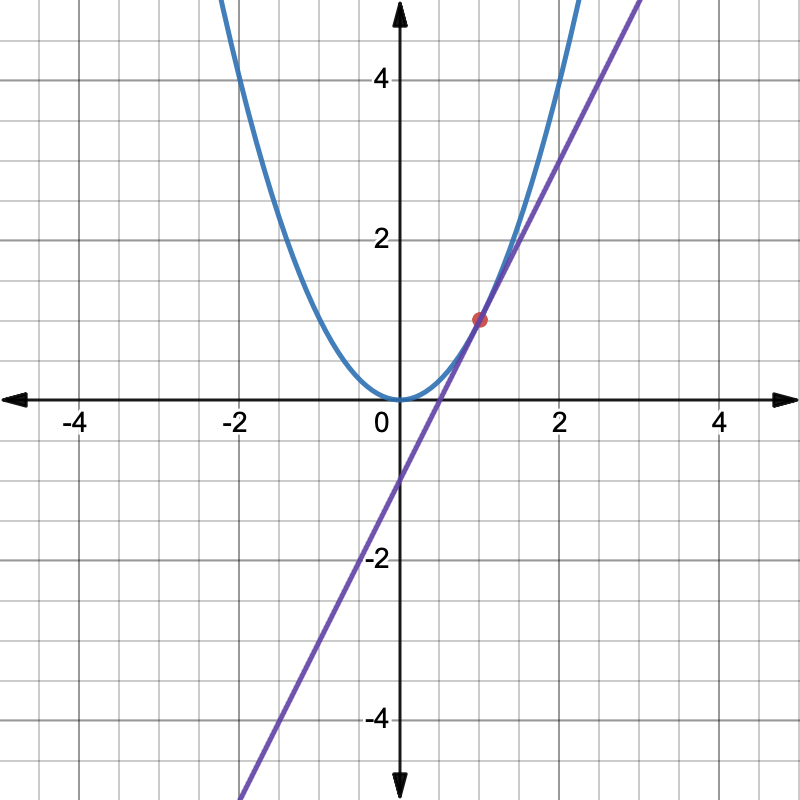
- Find an equation for the line tangent to $f$ at $x = 1$
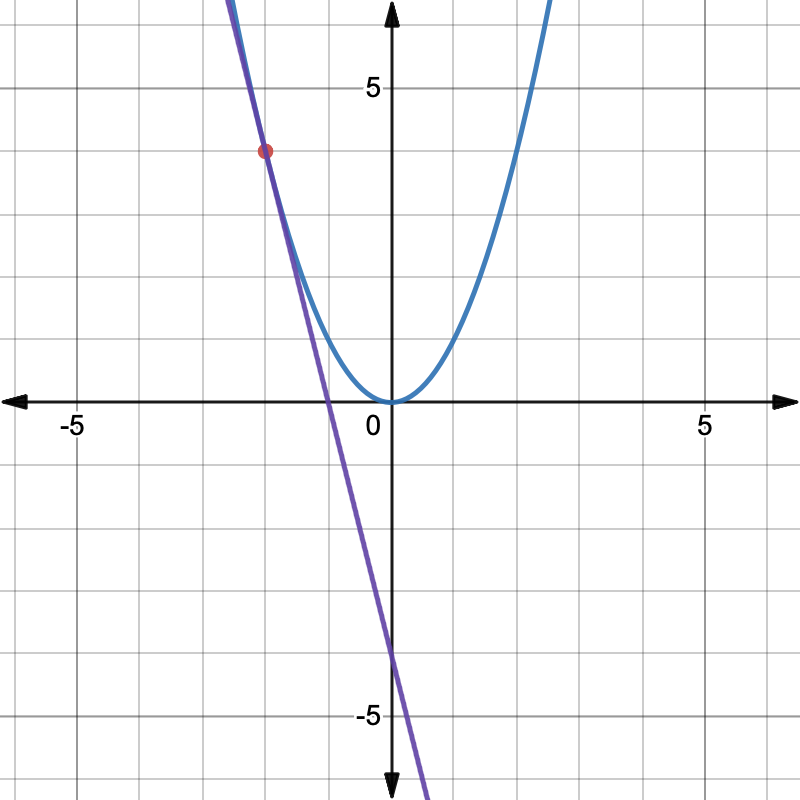
- Find an equation for the line tangent to $f$ at $x = -2$
Derivative:
As before, we can begin by simplifying $f(x+h)$ to make our work a little more organized:
$$ f(x+h) = (x+h)^2 = x^2 + 2xh + h^2 $$
Now let’s put it all together.
$$ \begin{aligned} f’(x) &= \lim_{h \to 0}\frac{f(x+h) - f(x)}{h}\cr &= \lim_{h \to 0}\frac{(x^2 + 2xh + h^2) - (x^2)}{h}\cr &= \lim_{h \to 0}\frac{x^2 + 2xh + h^2 - x^2}{h}\cr &= \lim_{h \to 0}\frac{2xh + h^2}{h}\cr &= \lim_{h \to 0}\frac{h(2x + h)}{h}\cr &= \lim_{h \to 0} (2x +h)\cr &= 2x + 0\cr &= \boxed{2x} \end{aligned} $$
This new function, $f’(x) = 2x$, is like a helper function for $f$. For any number that we plug into $f’$, we get information about $f$. In particular, $f’(a)$ gives us the slope of the line tangent to $f$ at $x = a$. Let’s apply that now.
Tangent line at $x = 1$:
The slope of the tangent line at $x = 1$, is
$$m = f’(1) = 2(1) = \boxed{2}$$
We also need the $y$-value that corresponds to $x_1 = 1$. For that, we plug into the original function, $f$:
$$y_1 = f(1) = (1)^2 = 1$$
So, we have
$$ \begin{aligned} y - y_1 &= m(x - x_1)\cr y - 1 &= 2(x - 1)\cr y - 1&= 2x - 2\cr y &= 2x - 1 \end{aligned} $$
Tangent line at $x = -2$:
The slope of the tangent line at $x = -2$, is
$$m = f’(-2) = 2(-2) = \boxed{-4}$$
We also need the $y$-value that corresponds to $x_1 = -2$. For that, we plug into the original function, $f$:
$$y_1 = f(-2) = (-2)^2 = 4$$
So, we have
$$ \begin{aligned} y - y_1 &= m(x - x_1)\cr y - 4 &= -4(x - (-2))\cr y - 4&= -4x - 8\cr y &= -4x - 4 \end{aligned} $$
Some important notes
- $f’(x)$ is NOT the slope of the tangent line to $f$, it GIVES US the slope when we PLUG IN. This is a crucial point and one that students often miss.
- Since $\lim_{h \to 0}\frac{f(x+h) - f(x)}{h}$ ALWAYS starts off as a $0/0$ (Case 2) limit, we should expect the $h$ in the denominator to cancel out at some point. With things line trig functions, logs, and exponentials, it’s a little more complicated, but for polynomials, rational functions, and radicals, we should be able to simplify and cancel.
Exercise
Consider $f(x) = \frac{1}{x}$.
- Find the derivative of $f$ using the limit definition.
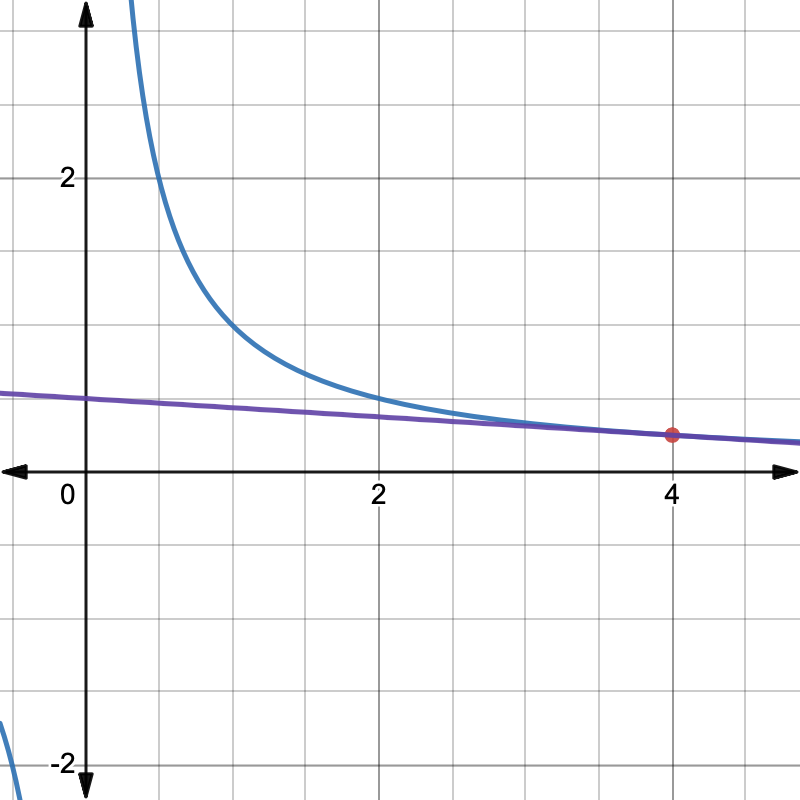
- Use the derivative to find an equation for the line tangent to $f$ at $x = 4$.
Solution
There’s not much simplifying we can do with $f(x+h) = \frac{1}{x+h}$, so let’s just plug in and see what we can do.
$$ \begin{aligned} f’(x) &= \lim_{h \to 0}\frac{f(x+h) - f(x)}{h}\cr &= \lim_{h \to 0}\frac{\frac{1}{x+h} - \frac{1}{h}}{h} \leftarrow \text{ combine fractions}\cr &= \lim_{h \to 0}\frac{\frac{x - (x + h)}{x(x+h)}}{h}\cr &= \lim_{h \to 0}\frac{\frac{-h)}{x(x+h)}}{h}\cr &= \lim_{h \to 0}\frac{-1)}{x(x+h)}\cr &= \frac{-1)}{x(x+(0))}\cr &= \boxed{-\frac{1}{x^2}} \end{aligned} $$
Tangent Line at x = 4:
The slope is $f’(4) = -\frac1{(4)^2} = -\frac{1}{16}$
The $y$-value that goes with $x = 4$ is $f(4) = \frac{1}{4}$
$$ \begin{aligned} y - y_1 &= m(x - x_1)\cr y - \frac{1}{4} = -\frac{1}{16}(x - 4)\cr y - \frac14 &= -\frac{1}{16}x + \frac14\cr y &= -\frac{1}{16}x + \frac12 \end{aligned} $$
Exercise
Consider the function $f(x) = \sqrt{x}$.
- Find the derivative of $f$ using the limit definition.
- Use the derivative to find an equation for the line tangent to $f$ at $x = 9$.
Solution
Derivative:
$$ \begin{aligned} f’(x) &= \lim_{h \to 0}\frac{f(x + h) - f(x)}{h}\cr &= \lim_{h \to 0}\frac{\sqrt{x+h} - \sqrt{x}}{h} \leftarrow \text{ multiply by conjugate}\cr &= \lim_{h \to 0}\frac{\sqrt{x+h} - \sqrt{x}}{h} \cdot \frac{\sqrt{x+h} + \sqrt{x}}{\sqrt{x+h} + \sqrt{x}}\cr &= \lim_{h \to 0}\frac{(x+h) - (x)}{h(\sqrt{x+h} + \sqrt{x})}\cr &= \lim_{h \to 0}\frac{h}{h(\sqrt{x+h} + \sqrt{x})} \leftarrow \frac{h}{h} = 1\cr &= \lim_{h \to 0}\frac{1}{\sqrt{x+h} + \sqrt{x}} \leftarrow \text{ plug in } h=0\cr &= \frac{1}{\sqrt{x + 0} + \sqrt{x}}\cr &= \boxed{\frac{1}{2\sqrt{x}}} \end{aligned} $$
Tangent Line:
We get the slope by plugging into $f’$:
$$m = f’(9) = \frac{1}{2\sqrt9} = \frac16$$
We get the $y$-value for our point of tangency by plugging into $f$:
$$f(9) = \sqrt9 = 3$$
Putting it all together:
$$ \begin{aligned} y - y_1 &= m(x - x_1)\cr y - 3 &= \frac16(x - 9)\cr y - 3 &= \frac16x - \frac32\cr \end{aligned} $$
$$\boxed{y = \frac16x + \frac32}$$

Digging Deeper
The derivative of a function tells us a lot about the function itself. In a later section, we’ll do in-depth analyses of functions using the first and second derivatives. That said, we can start exploring the relationships between $f$ and $f’$ now.
Differentiability
We say that a function $f$ is differentiable at $x = a$ provided that $f’$ is continuous at $x = a.$
Differentiability is a stronger condition than continuity, so a function can be continuous but not differentiable, but not the other way around.
Example
Remember that the absolute value function $f(x) = |x|$ is really a piecewise function:
$$ |x| = \begin{cases} x, x \geq 0\cr -x, x < 0 \end{cases} $$
This function is continuous everywhere (go through the conditions for continuity for $f$ if you’re not sure why that’s true). But is it differentiable everywhere?
Since $f$ is piecewise, so is $f’$. We have to find the derivative of each piece.
$x > 0: f(x) = x$
$$ \begin{aligned} f’(x) &= \lim_{h \to 0}\frac{f(x + h) - f(x)}{h}\cr &= \lim_{h \to 0}\frac{(x + h) - (x)}{h}\cr &= \lim_{h \to 0}\frac{h}{h}\cr &= 1 \end{aligned} $$
This should make sense since the slope of $y = x$ is $1$ everywhere!
$x < 0: f(x) = -x$
$$ \begin{aligned} f’(x) &= \lim_{h \to 0}\frac{f(x + h) - f(x)}{h}\cr &= \lim_{h \to 0}\frac{-(x + h) - (-x)}{h}\cr &= \lim_{h \to 0}\frac{-h}{h}\cr &= -1 \end{aligned} $$
Again, this should make sense since the slope of $y = -x$ is $-1$.
How about at $x = 0$? Well, if we’re right at $x = 0$, the slope depends on which side we’re on:
$$\lim_{h \to 0^{-}}f(x) = -1 \qquad \lim_{h \to 0^{-}}f(x) = 1$$
Since $\lim_{h \to 0^{-}}f(x) \neq \lim_{h \to 0^{-}}f(x)$, $f’(0)$ is undefined. This means that $f’$ is discontinuous at $x = 0$. When this occurs we say that $f$ is no differentiable.
Differentiable Functions
We say that $f$ is differentiable wherever $f’$ is continuous. Note that a function can be continuous at point without being differentiable there, but the opposite can’t be true; when $f$ is differentiable it is also continuous.
Differentiability is a stronger condition than continuity. It tells us that the graph of $f$ is not only continuous, but it is also smooth.
Exercise
Based on the graph of $f$, shown below, place the following quantities in order:
$$ f’(-2)\quad f’(-1) \quad f’(0) \quad f’(1) $$
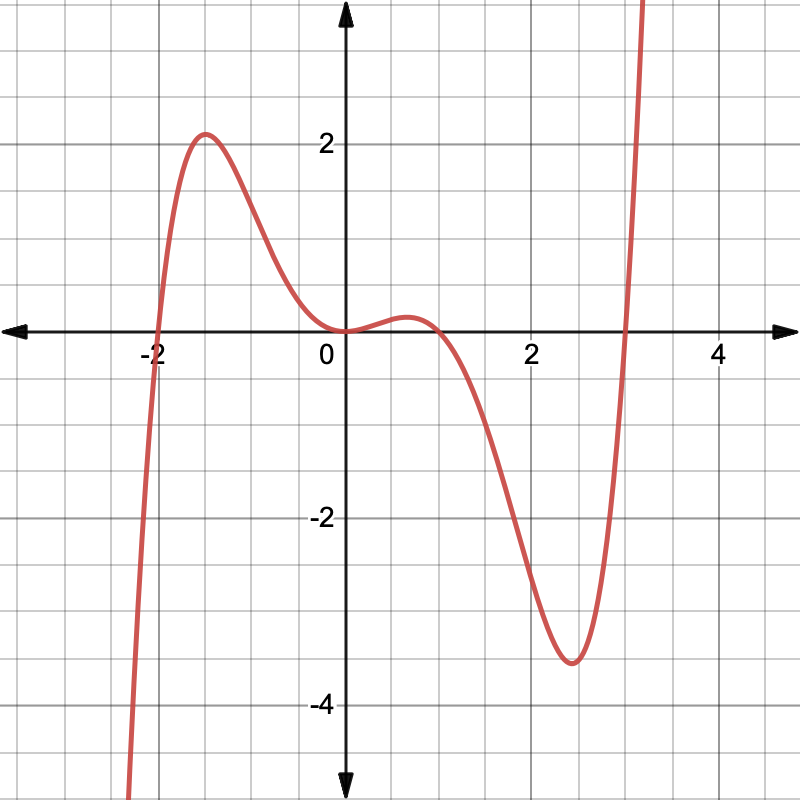
Remember, the graph we’re given here is the graph of $f$.
Solution
Let’s start by separating these derivative values positive, negative, and zero.
- At $x = 0$, the tangent line is horizontal. Horizontal lines have a slope of $0$, so $f’(0) = 0$.
- At $x = -2$, the slope of the tangent line is positive, so $f’(-2) > 0$.
- Finally, at $x = -1$ and $x = 1$, the slopes are negative, so $f’(-1) < 0$ and $f’(1) < 0$.
Now we just need to put the negative ones in order.
- The graph is steeper at $x = -1$ than it is at $x = 1$, so $f’(-1) < f(1)$.
Thus,
$$\boxed{f’(-1) < f’(1) < f’(0) < f’(-2)}$$