Local Linear Approximation
Local linear approximation is a technique we can use to approximate the values of functions that we’re unable to compute directly. For example, we have no direct way of computing $\sin(34^\circ)$. The same goes for $\ln(1.2)$ or $\sqrt[3]{8.2}$.
For a differentiable function, its tangent lines can be good approximations of the function if we’re close to the point of tangency. In fact, we often say that when a function is differentiable it is locally linear.
Big Picture
Recall that a function being differentiable means that its derivative is continuous. Visually, this tells us that the graph of the function is smooth. What does it mean to be smooth? In the past, we’ve said that a smooth curve has no corners or cusps. Another way of describing smooth curve is to say that it is locally linear.
To say that a curve is locally linear is to say that the more we zoom in on the curve, the flatter it looks. This is precisely why our day-to-day experience of standing on a spherical earth is flatness. It’s not that earth is flat (take note, flat-earthers), but rather that the scale at which we observe the earth is so tiny, that it looks flat. We have to zoom way out to see it’s spherical shape.
Local linearity is not just a nice description; it’s a property we can use to perform a special kind of approximation of functions. Consider the square root function, $f(x) = \sqrt{x}$. We know that it’s continuous and differentiable on $(0,\infty)$, but we can only evaluate it directly at certain $x$-values: perfect squares. Let’s make use of local linearity to approximate $\sqrt{3.8}$.
Example
Let’s begin by finding an equation for the line tangent to $f(x) = \sqrt{x}$ at $x = 4$. You should be able to do this part yourself.
Solution
We’re given $x_0 = 4$. To find the corresponding value, we plug into $f$:
$$y_0 = f(x_0) = \sqrt{4} = 2$$
Next, we need the derivative.
$$ \begin{aligned} f’(x) &= \frac12 x^{-1/2}\cr &= \frac{1}{2\sqrt{x}} \end{aligned} $$
Plugging $x_0$ into $f’$ gives us the slope:
$$f’(4) = \frac{1}{2\sqrt4} = \frac14$$
Tangent Line: $y - 2 = \frac14(x - 4)$.
This might seem weird at first, but we’re going to leave the line in this form:
$$ \begin{aligned} y - 2 &= \frac14(x - 4)\cr y &= \frac14(x - 4) + 2 \end{aligned} $$
Okay, now we have an equation for the line tangent to $f$ at $x = 4$. How does that help us approximate $\sqrt{3.8}$? Let’s take a look at the graph.
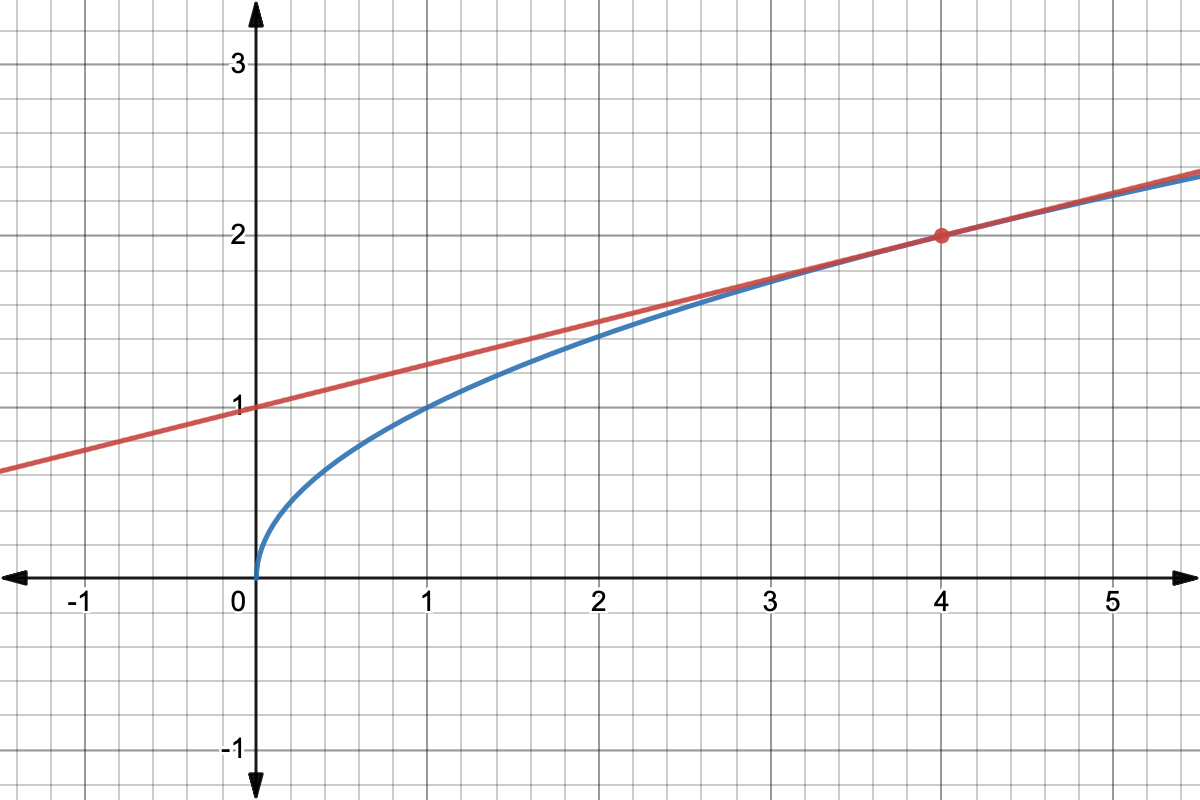
Notice that around $x = 4$, the tangent line is almost indistinguishable from the graph of $f$. Let’s zoom way in around $x = 3.8$.
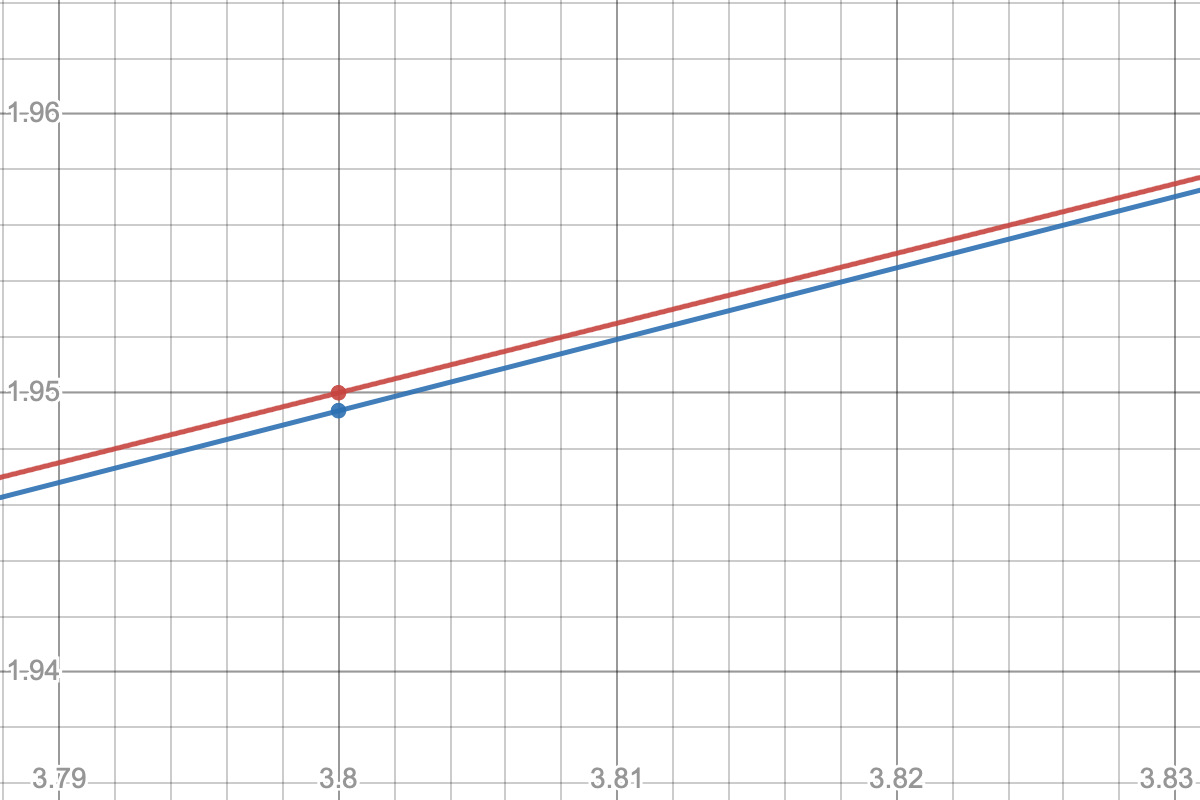
Look at how close the $y$-values of the function and the tangent line are!
The $y$-value for the tangent line is
$$ \begin{aligned} y(3.8) &= \frac14(3.8 - 4) + 2\cr &= \frac14(-0.2) + 2\cr &= -\frac{2}{40} + 2\cr &= -\frac{1}{20} + 2\cr &= \frac{39}{20} \end{aligned} $$
It’s safe to say that $\boxed{\sqrt{3.8} \approx \frac{39}{20}}$. We just completed our first Local Linear Approximation.
local linear approximation outline
If we want to approximate $f(x_1)$, we can do the following:
- Choose a point of tangency that satisfies the following conditions:
- $f$ is differentiable at $x = x_0$ and everywhere in between $x_0$ and $x_1$.
- We can evaluate $f(x_0)$ directly.
- $x_0$ should be close to $x_1$.
- Find an equation for the tangent line
- It’s helpful to put it in the form $L(x) = f’(x_0)(x-x_0) + f(x_0)$, but isn’t necessary.
- $f(x_1) \approx L(x_1)$.
Example
Approximate $\sqrt[3]{8.2}$.
Let $f(x) = \sqrt[3]{x}$. Since we know $\sqrt[3]{8}$, we’ll use $x = 8$ as our point of tangency.
Tangent line/linearization:
$$ \begin{aligned} x_0 &= 8\cr y_0 &= f(8) = 2\cr f’(x) &= \frac13 x^{-2/3}\cr &= \frac{1}{3\sqrt[3]{x^2}}\cr f’(8) &= \frac{1}{12}\cr L(x) &= \frac1{12}(x - 8) + 2 \end{aligned} $$
Approximation:
$$ \begin{aligned} \sqrt[3]{8.2} &\approx L(8.2)\cr &\approx \frac1{12}(8.2 - 8) + 2\cr &\approx \frac1{12}(0.2) + 2\cr &\approx \frac{2}{120} + 2\cr &\approx \frac{1}{60} + 2\cr &\approx \boxed{\frac{121}{60}} \end{aligned} $$
Exercise
Approximate $\sqrt[4]{80.5}$.
Solution
Let $f(x) = \sqrt[4]{x}$. We can evaluate $f(81)$ directly ($\sqrt[4]{81} = 3$), so we’ll make $x_0 = 81$ our point of tangency.
- $y_0$-value: $f(81) = 3$
- Slope
$$ \begin{aligned} f’(x) &= \frac14 x^{-3/4}\cr &= \frac{1}{4\sqrt[4]{x^3}}\cr m &= f’(81)\cr &= \frac{1}{4\sqrt[4]{81^3}} & \boxed{\text{Note, we can compute $(\sqrt[4]{81})^3$}}\cr &= \frac{1}{4(27)}\cr &= \frac{1}{108} \end{aligned} $$
- Tangent Line:
$$ \begin{aligned} L(x) &= \frac1{108}(x - 81) + 3 \end{aligned} $$
- Approximation:
$$ \begin{aligned} \sqrt[4]{80.5} &\approx L(80.5)\cr &\approx \frac1{108}(80.5 - 81) + 3\cr &\approx \frac1{108}(-0.5) + 3\cr &\approx -\frac1{216} + 3\cr &\approx \boxed{\frac{647}{216}} \end{aligned} $$
Example
Approximate $\tan(40^\circ)$.
Let $f(x) = \tan x$. We’ll use $x = 45^\circ = \pi/4$ for our point of tangency.
$$ \begin{aligned} x_0 &= \pi/4\cr y_0 &= f(\pi/4) = 1\cr f’(x) &= \sec^2(x)\cr m &= f’(\pi/4)\cr &= (\sqrt2/2)^2\cr &= 2\cr L(x) &= 2(x - 45^\circ) + 1 & \boxed{\text{leave like this to make plugging in easier}} \end{aligned} $$
Approximation:
$$ \begin{aligned} \tan(40^\circ) &\approx L(40^\circ)\cr &\approx 2(40^\circ - 45^\circ) + 1\cr &\approx 2(-5^\circ) + 1\cr &\approx -10^\circ + 1\cr &\approx -\frac{\pi}{18} + 1\cr &\approx \boxed{1 - \frac{\pi}{18}} \end{aligned} $$
Example
Let’s approximate $\ln 3$. Since $e \approx 2.7$, and we know $\ln e = 1$, we can use that for our point of tangency.
Let $f(x) = \ln x$.
Then $f’(x) = \frac1x$.
$$ \begin{aligned} L(x) &= f’(e)(x - e) + f(e)\cr &= \frac1e(x - e) + 1\cr \ln(3) &\approx L(3)\cr &\approx \frac1e(3 - e) + 1\cr &\approx \frac3e - 1 + 1\cr &\approx \boxed{\frac3e} \end{aligned} $$
Exercise
Approximate $\ln 1.2$.
Let $f(x) = \ln x$. We’ll use $x = 1$ as our point of tangency. $$
\begin{aligned}
f’(x) &= \frac1x\cr
L(x) &= f’(1)(x - 1) + f(1)\cr
&= (1)(x - 1) + 0\cr
&= x - 1\cr
\ln(1.2) &\approx L(1.2)\cr
&\approx 1.2 - 1\cr
&\approx \boxed{0.2}
\end{aligned}
$$Solution