Definite Integrals
In the last section, we defined the Riemann Sum, which we used to compute the exact net-signed area enclosed between the graph of a function and the $x$-axis over a given interval. Now, we’re going to clarify what we mean by net-signed area and introduce some new notation to refer to this kind of calculation. This new notation is called the definite integral.
Net-Signed Area
Recall that the Riemann sum has the following form:
$$ \lim_{ n \to \infty } \sum_{k=1}^n \underbrace{f(x_{k}^{*})}_{\text{height}}\overbrace{\Delta x}^{\text{width}} $$ But, what happens when $f$ is negative (and the graph is below the $x$-axis)?
Well, $\Delta x$ is always positive, so we’ll get a negative value for the product $f(x_{k}^{*})\Delta x$!
This means that the Riemann sum treats regions below the $x$-axis as having “negative area.” Since it doesn’t really make sense to talk about “negative area,” we define a new concept: net-signed area.
Definite Integral
Suppose, once again, that we have a function $f$ and an interval $[a,b]$ on which $f$ is continuous. We represent the net-signed area bounded between the graph of $f$ and the $x$-axis as follows:
$$ \int_{a}^b f(x) dx $$
Positive and Negative Area
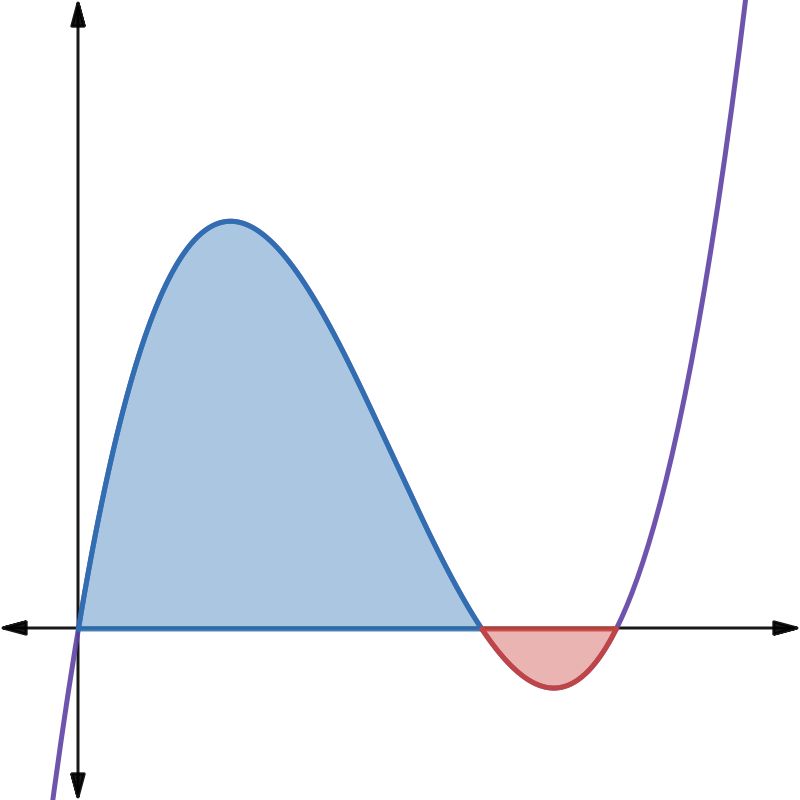
When evaluating net-signed area, the blue-shaded region would have a positive-valued area because it’s above the $x$-axis, while the red-shaded area would have a negative-valued area because it’s below the $x$-axis.
Example
Consider the graph of $f$, shown below along with the area (not signed) of each shaded region.
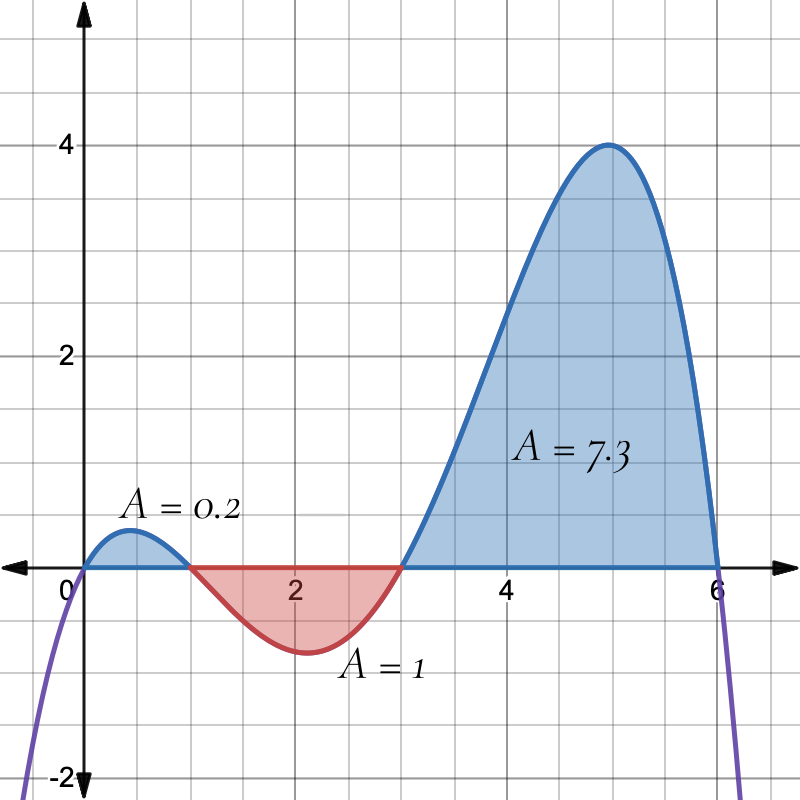
Here are some of the definite integrals we can compute based on these values:
- $\int_{0}^{1} { f(x) } \ dx = 0.2$
- $\int_{1}^{3} { f(x) } \ dx = - 1$ because it’s below the $x$-axis
- $\int_{3}^{6} { f(x) } \ dx = 7.3$
- $\int_{0}^{6} { f(x) } \ dx = 0.2 - 1 + 7.3 = 6.5$
- $\int_{0}^{3} { f(x) } \ dx = 0.2 - 1 = -0.8$
Why would we want net-signed area and not just area?
One application to consider is the average value of a continuous function. When we compute the average of something like 30 exam scores, we just add up the 30 scores and divide by 30. But what about a continuous function?
We can define average value for a continuous function over $[a,b]$ as follows: $$\frac{1}{b - a}\int_{a}^b f(x) \ dx$$ In the case of the problem we did above, the average value of $f(x) = 2x$ over $[-1,2]$ is $\frac{1}{3}({3}) = 1$
Definite Integrals as Riemann Sums
We can take any of the areas we found in the previous section and express them as definite integrals.
Example
Consider the region enclosed between $f(x) = x^2$ and the $x$-axis over $[0,2]$.
If we use right endpoints, we get
- $\Delta x = \frac{2}{n}$
- $x_k^{*} = 0 + k\cdot \frac2n = \frac{2k}{n}$
- $f(x_{k}^{*}) = \left(\frac{2k}{n}\right)^2 = \frac{4k^2}{n^2}$
- $f(x_{k}^{*}) \cdot \Delta x = \frac{8k^2}{n^3}$
$$ \int_{0}^{2} f(x) \ dx = \lim_{n \to \infty}\sum_{k = 1}^{n} \frac{8k^2}{n^3} $$
Exercise
Write a Riemann Sum for $\int_{1}^{5} \sin(x) \ dx$ using left endpoints (don’t try to evaluate it!).
Solution
First, we’ll assemble our pieces:
- $[a,b] = [1,5]$
- $\Delta x = \frac{5 - 1}{n} = \frac4n$
- $x_k^{*} = 1 + (k - 1) \Delta x = 1 + (k - 1)\frac4n$
- $f(x_k^{*}) = \sin\left(1 + (k - 1)\frac4n\right)$
$$ \boxed{\int_{1}^{5} { \sin(x) } \ dx = \lim_{n \to \infty}\sum_{k=1}^{n} { \sin\left(1 + (k - 1)\frac4n\right) \frac4n }} $$
Exercise
Write a definite integral that corresponds to the sum $\lim_{n \to \infty}\sum_{k=1}^{n} { \ln\left(3 + \frac{6k}{n}\right)\frac{6}{n} }$
Solution
This is a little trickier.
First, notice that our $\Delta x = \frac6n$. That means the length of our interval must be $6$ (since $b - a = 6$).
Next, we note that our function must be $\ln x$.
Finally, we have that $x_k^{*} = 3 + \frac{6k}{n}$, so $a = 3$. Since our interval is $6$ units long, we must have $[3,9]$.
Putting all that together, we get
$$ \boxed{\lim_{n \to \infty}\sum_{k=1}^{n} { \ln\left(3 + \frac{6k}{n}\right)\frac{6}{n} } = \int_{3}^{9} { \ln x } \ dx} $$
Properties of the Definite Integral
The definite integral has some really useful properties that follow directly from its definition.
Integral of a Sum of Functions
We can split the integral of a sum into a sum of integrals:
$$ \int_{a}^{b} { (f(x) + g(x)) } \ dx = \int_{a}^{b} { f(x) } \ dx + \int_{a}^{b} { g(x) } \ dx $$
Proof
This follows directly from the Riemann Sum:
$$ \begin{aligned} \int_{a}^{b} { (f(x) + g(x)) } \ dx &= \lim_{n \to \infty}\sum_{k=1}^{n} { (f(x_k^{*}) + g(x_k^{*}))\Delta x }\cr &= \lim_{n \to \infty}\sum_{k=1}^{n} { (f(x_k^{*})\Delta x + g(x_k^{*})\Delta x )}\cr &= \lim_{n \to \infty}\left(\sum_{k=1}^{n} { f(x_k^{*})\Delta x + \sum_{k=1}^{n}g(x_k^{*})\Delta x }\right)\cr &= \int_{a}^{b} { f(x) } \ dx + \int_{a}^{b} { g(x) } \ dx \end{aligned} $$
Joining Intervals
If we integrate a function from $x = a$ to $x = b$ and then from $x = b$ to $x = c$, we’ve effectively integrated from $x = a$ to $x = c$:
$$ \int_{a}^{b} { f(x) } \ dx + \int_{b}^{c} { f(x) } \ dx = \int_{a}^{c} { f(x) } \ dx $$
Constant Multiple
Constants can be pulled out of integrals.
$$ \int_{a}^{b} { cf(x) } \ dx = c\int_{a}^{b} { f(x) } \ dx $$
Proof
This one also follows directly from the Riemann Sum:
$$ \begin{aligned} \int_{a}^{b} { cf(x) } \ dx &= \lim_{n \to \infty}\sum_{k=1}^{n} { cf(x_k^{*}) \Delta x }\cr &= \lim_{n \to \infty}c\sum_{k=1}^{n} { f(x_k^{*}) \Delta x }\ & \ \boxed{\text{we can factor out of sums}}\cr &= c\lim_{n \to \infty}\sum_{k=1}^{n} { f(x_k^{*}) \Delta x }\ & \ \boxed{\text{constants can come out of limits, too}}\cr &= c\int_{a}^{b} { f(x) } \ dx \end{aligned} $$
Reversing the Bounds
If we flip the bounds, we flip the sign of the integral. For now, we’ll just take this to a definition. Once we’ve discussed the Fundamental Theorem of Calculus, we’ll have a better understanding of why this is true.
$$ \int_{b}^{a} { f(x) } \ dx = - \int_{a}^{b} { f(x) } \ dx $$
Example
Suppose we know that $\int_{2}^{5} { f(x) } \ dx = 5$ and $\int_{2}^{5} { g(x) } \ dx = -3$. We can evaluate
$$ \int_{2}^{5} { f(x) - g(x) } \ dx $$
using the integral of a sum property.
$$ \begin{aligned} \int_{2}^{5} { f(x) - g(x) } \ dx &= \int_{2}^{5} { f(x)} \ dx - \int_{2}^{5} { g(x)} \ dx\cr &= 5 - (-3)\cr &= \boxed{8} \end{aligned} $$
Example
Suppose that $\int_{1}^{8} { f(x) } \ dx = 9$ and $\int_{5}^{8} { f(x) } \ dx = 5$. Evaluate
$$ \int_{1}^{5} { f(x) } \ dx $$
Let’s write out the joining intervals property for $[1,5]$, $[5,8]$, and $[1,8]$:
$$ \begin{aligned} \int_{1}^{5} { f(x) } \ dx + \int_{5}^{8} { f(x) } \ dx &= \int_{1}^{8} { f(x) } \ dx\cr \int_{1}^{5} { f(x) } \ dx + 5 &= 8 \ & \ \boxed{\text{now we solve!}}\cr \int_{1}^{5} { f(x) } \ dx &= 8 - 5\cr \int_{1}^{5} { f(x) } \ dx &= \boxed{3}\cr \end{aligned} $$
Exercise
Suppose we know the following:
$$ \int_{3}^{7} { f(x) } \ dx = -2, \quad \int_{3}^{7} { g(x) } \ dx = 6, $$
$$ \int_{1}^{3} { f(x) } \ dx = 8, \quad \int_{1}^{7} { f(x) + g(x) } \ dx = 13 $$
Evaluate $\int_{1}^{3} { g(x) } \ dx$ using properties of the definite integral.
Solution
First, we can say that
$$ \begin{aligned} \int_{1}^{7} { f(x) } \ dx &= \int_{3}^{7} { f(x) } \ dx + \int_{1}^{3} { f(x) } \ dx\cr &= -2 + 8\cr &= 6 \end{aligned} $$
Then, we have
$$ \begin{aligned} \int_{1}^{7} { f(x) + g(x) } \ dx &= \int_{1}^{7} { f(x) } \ dx + \int_{1}^{7} { g(x) } \ dx\cr 13 &= 6 + \int_{1}^{7} { g(x) } \ dx\cr \int_{1}^{7} { g(x) } \ dx &= 7 \end{aligned} $$
Finally,
$$ \begin{aligned} \int_{1}^{7} { g(x) } \ dx &= \int_{1}^{3} { g(x) } \ dx + \int_{3}^{7} { g(x) } \ dx\cr 7 &= \int_{1}^{3} { g(x) } + 6\cr \int_{1}^{3} { g(x) } &= \boxed{1} \end{aligned} $$
Example
Consider the graph of $f(x) = 2x$ over $[-1,2]$.
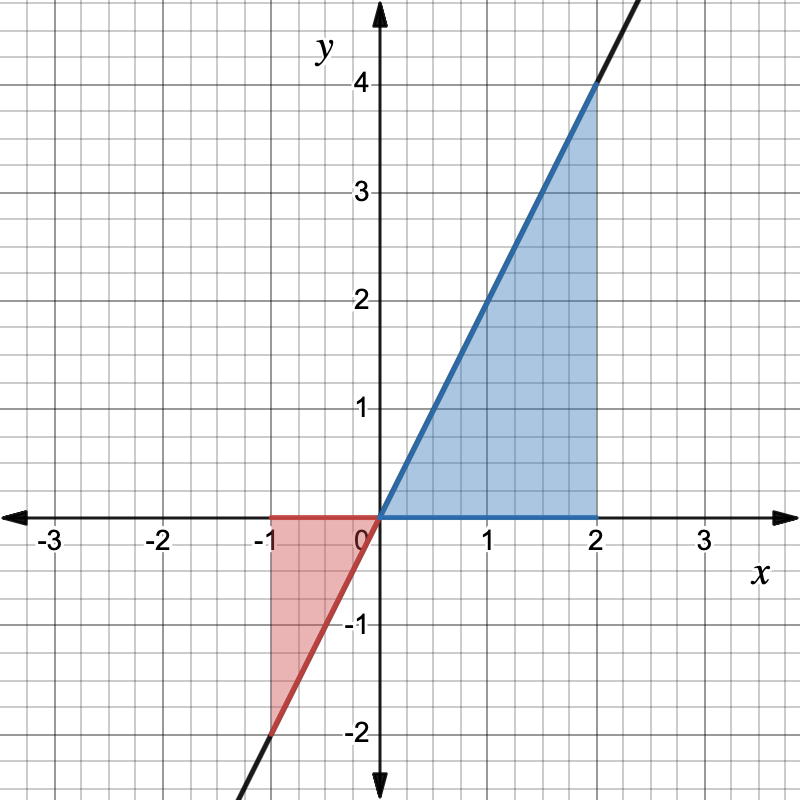 We can compute $\int_{-1}^2 2x dx$ using familiar formulas from geometry.
- The portion shaded in red has an area of $\frac{1}{2}(1)(2) = 1$.
- The portion shaded in blue has an area of $\frac{1}{2}(2)(4) = 4$.
Since we want net-signed area, we need to assign the red region a negative value:
$$ \int_{-1}^{2} 2x \ dx = 4 - 1 = \boxed{3} $$
Exercise
Compute the value of the following definite integral using only familiar formulas from geometry:
$$ \int_{0}^{3} 5 - x , dx $$
Solution
We’ll start with a sketch of the graph:
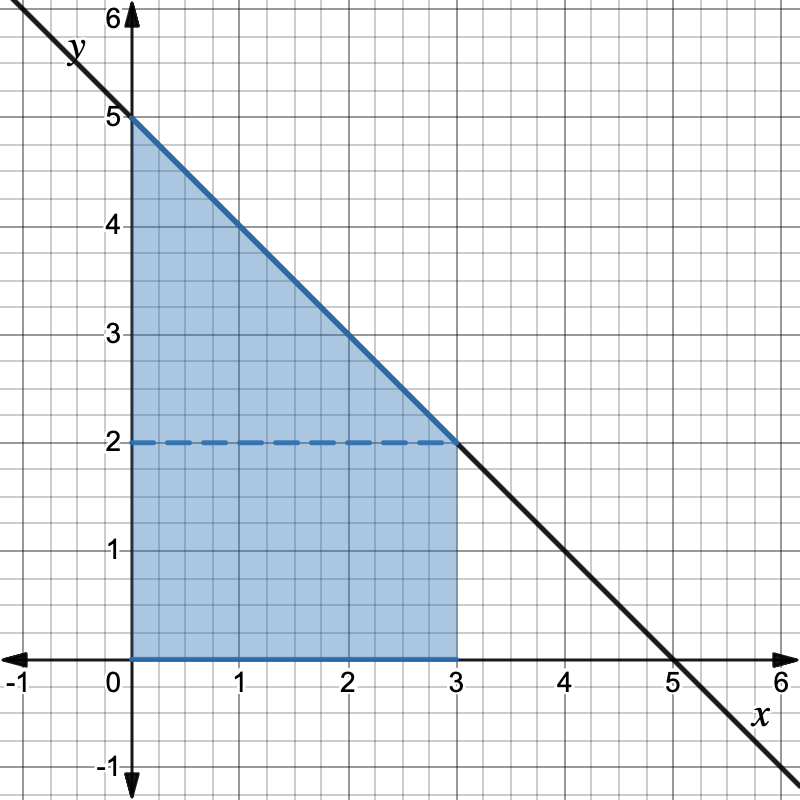
I’ve added a dotted line to split the area into two geometric shapes: a rectangle and a right triangle.
- Rectangle: $(3)(2) = 6$
- Triangle: $\frac{1}{2}(3)(3) = \frac{9}{2}$
$$ \int_{0}^{3} 5 - x \ dx = 6 + \frac{9}{2} = \boxed{\frac{21}{2}} $$
Example
Consider the region enclosed between $f(x) = x^2$ and the $x$-axis over $[0,2]$.
If we use right endpoints, we get
- $\Delta x = \frac{2}{n}$
- $x_k^{*} = 0 + k\cdot \frac2n = \frac{2k}{n}$
- $f(x_{k}^{*}) = \left(\frac{2k}{n}\right)^2 = \frac{4k^2}{n^2}$
- $f(x_{k}^{*}) \cdot \Delta x = \frac{8k^2}{n^3}$
$$ \int_{0}^{2} f(x) \ dx = \lim_{n \to \infty}\sum_{k = 1}^{n} \frac{8k^2}{n^3} $$
Exercise
Write a Riemann Sum for $\int_{1}^{5} \sin(x) \ dx$ using left endpoints (don’t try to evaluate it!).
Solution
First, we’ll assemble our pieces:
- $[a,b] = [1,5]$
- $\Delta x = \frac{5 - 1}{n} = \frac4n$
- $x_k^{*} = 1 + (k - 1) \Delta x = 1 + (k - 1)\frac4n$
- $f(x_k^{*}) = \sin\left(1 + (k - 1)\frac4n\right)$
$$ \boxed{\int_{1}^{5} { \sin(x) } \ dx = \lim_{n \to \infty}\sum_{k=1}^{n} { \sin\left(1 + (k - 1)\frac4n\right) \frac4n }} $$
Exercise
Write a definite integral that corresponds to the sum $\lim_{n \to \infty}\sum_{k=1}^{n} { \ln\left(3 + \frac{6k}{n}\right)\frac{6}{n} }$
Solution
This is a little trickier.
First, notice that our $\Delta x = \frac6n$. That means the length of our interval must be $6$ (since $b - a = 6$).
Next, we note that our function must be $\ln x$.
Finally, we have that $x_k^{*} = 3 + \frac{6k}{n}$, so $a = 3$. Since our interval is $6$ units long, we must have $[3,9]$.
Putting all that together, we get
$$ \boxed{\lim_{n \to \infty}\sum_{k=1}^{n} { \ln\left(3 + \frac{6k}{n}\right)\frac{6}{n} } = \int_{3}^{9} { \ln x } \ dx} $$
Properties of the Definite Integral
The definite integral has some really useful properties that follow directly from its definition.
Integral of a Sum of Functions
We can split the integral of a sum into a sum of integrals:
$$ \int_{a}^{b} { (f(x) + g(x)) } \ dx = \int_{a}^{b} { f(x) } \ dx + \int_{a}^{b} { g(x) } \ dx $$
Proof
This follows directly from the Riemann Sum:
$$ \begin{aligned} \int_{a}^{b} { (f(x) + g(x)) } \ dx &= \lim_{n \to \infty}\sum_{k=1}^{n} { (f(x_k^{*}) + g(x_k^{*}))\Delta x }\cr &= \lim_{n \to \infty}\sum_{k=1}^{n} { (f(x_k^{*})\Delta x + g(x_k^{*})\Delta x )}\cr &= \lim_{n \to \infty}\left(\sum_{k=1}^{n} { f(x_k^{*})\Delta x + \sum_{k=1}^{n}g(x_k^{*})\Delta x }\right)\cr &= \int_{a}^{b} { f(x) } \ dx + \int_{a}^{b} { g(x) } \ dx \end{aligned} $$
Joining Intervals
If we integrate a function from $x = a$ to $x = b$ and then from $x = b$ to $x = c$, we’ve effectively integrated from $x = a$ to $x = c$:
$$ \int_{a}^{b} { f(x) } \ dx + \int_{b}^{c} { f(x) } \ dx = \int_{a}^{c} { f(x) } \ dx $$
Constant Multiple
Constants can be pulled out of integrals.
$$ \int_{a}^{b} { cf(x) } \ dx = c\int_{a}^{b} { f(x) } \ dx $$
Proof
This one also follows directly from the Riemann Sum:
$$ \begin{aligned} \int_{a}^{b} { cf(x) } \ dx &= \lim_{n \to \infty}\sum_{k=1}^{n} { cf(x_k^{*}) \Delta x }\cr &= \lim_{n \to \infty}c\sum_{k=1}^{n} { f(x_k^{*}) \Delta x }\ & \ \boxed{\text{we can factor out of sums}}\cr &= c\lim_{n \to \infty}\sum_{k=1}^{n} { f(x_k^{*}) \Delta x }\ & \ \boxed{\text{constants can come out of limits, too}}\cr &= c\int_{a}^{b} { f(x) } \ dx \end{aligned} $$
Reversing the Bounds
If we flip the bounds, we flip the sign of the integral. For now, we’ll just take this to a definition. Once we’ve discussed the Fundamental Theorem of Calculus, we’ll have a better understanding of why this is true.
$$ \int_{b}^{a} { f(x) } \ dx = - \int_{a}^{b} { f(x) } \ dx $$
Example
Suppose we know that $\int_{2}^{5} { f(x) } \ dx = 5$ and $\int_{2}^{5} { g(x) } \ dx = -3$. We can evaluate
$$ \int_{2}^{5} { f(x) - g(x) } \ dx $$
using the integral of a sum property.
$$ \begin{aligned} \int_{2}^{5} { f(x) - g(x) } \ dx &= \int_{2}^{5} { f(x)} \ dx - \int_{2}^{5} { g(x)} \ dx\cr &= 5 - (-3)\cr &= \boxed{8} \end{aligned} $$
Example
Suppose that $\int_{1}^{8} { f(x) } \ dx = 9$ and $\int_{5}^{8} { f(x) } \ dx = 5$. Evaluate
$$ \int_{1}^{5} { f(x) } \ dx $$
Let’s write out the joining intervals property for $[1,5]$, $[5,8]$, and $[1,8]$:
$$ \begin{aligned} \int_{1}^{5} { f(x) } \ dx + \int_{5}^{8} { f(x) } \ dx &= \int_{1}^{8} { f(x) } \ dx\cr \int_{1}^{5} { f(x) } \ dx + 5 &= 8 \ & \ \boxed{\text{now we solve!}}\cr \int_{1}^{5} { f(x) } \ dx &= 8 - 5\cr \int_{1}^{5} { f(x) } \ dx &= \boxed{3}\cr \end{aligned} $$
Exercise
Suppose we know the following:
$$ \int_{3}^{7} { f(x) } \ dx = -2, \quad \int_{3}^{7} { g(x) } \ dx = 6, $$
$$ \int_{1}^{3} { f(x) } \ dx = 8, \quad \int_{1}^{7} { f(x) + g(x) } \ dx = 13 $$
Evaluate $\int_{1}^{3} { g(x) } \ dx$ using properties of the definite integral.
Solution
First, we can say that
$$ \begin{aligned} \int_{1}^{7} { f(x) } \ dx &= \int_{3}^{7} { f(x) } \ dx + \int_{1}^{3} { f(x) } \ dx\cr &= -2 + 8\cr &= 6 \end{aligned} $$
Then, we have
$$ \begin{aligned} \int_{1}^{7} { f(x) + g(x) } \ dx &= \int_{1}^{7} { f(x) } \ dx + \int_{1}^{7} { g(x) } \ dx\cr 13 &= 6 + \int_{1}^{7} { g(x) } \ dx\cr \int_{1}^{7} { g(x) } \ dx &= 7 \end{aligned} $$
Finally,
$$ \begin{aligned} \int_{1}^{7} { g(x) } \ dx &= \int_{1}^{3} { g(x) } \ dx + \int_{3}^{7} { g(x) } \ dx\cr 7 &= \int_{1}^{3} { g(x) } + 6\cr \int_{1}^{3} { g(x) } &= \boxed{1} \end{aligned} $$
Evaluating Definite Integrals with Geometry
Soon, we’ll learn that definite integrals can be evaluated using antiderivatives. However, it’s very important that we remember what the definite integral represents. This isn’t just a matter of conceptual understanding; we’ll encounter several situations over the next couple chapters where, because computing antiderivatives can sometimes be unmanageable, using geometry to evaluate a definite integral is the best way to do it.
Here’s an example:
Example
Let’s use geometry to evaluate
$$ \int_{0}^{2} { \sqrt{4 - x^2} } \ dx $$
This definite integral represents the net-signed area bounded between $f(x) = \sqrt{4 - x^2}$ and the $x$-axis over $[0,2]$.
The graph of $f$ is a half-circle with radius $2$, centered at the origin.
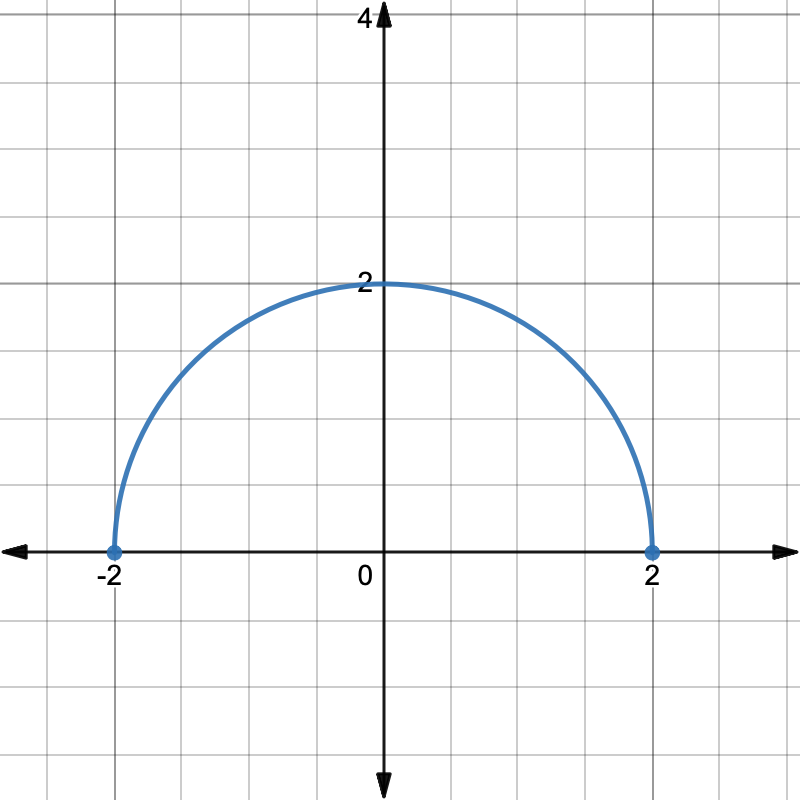
We want the area enclosed by the circle and the $x$-axis from $x = 0$ to $x = 2$.
That means we want one quarter of the area of the full circle:
$$A = \frac14 \pi (2)^2 = \pi$$
So,
$$ \boxed{\int_{0}^{2} { \sqrt{4 - x^2} } \ dx = \pi} $$
Let’s try another.
Example
This time we’ll evaluate
$$ \int_{-1}^{2} { 2x } \ dx $$
Now we want the net-signed area enclosed by $f(x) = 2x$ and the $x$-axis from $x = -1$ to $x = 2$.
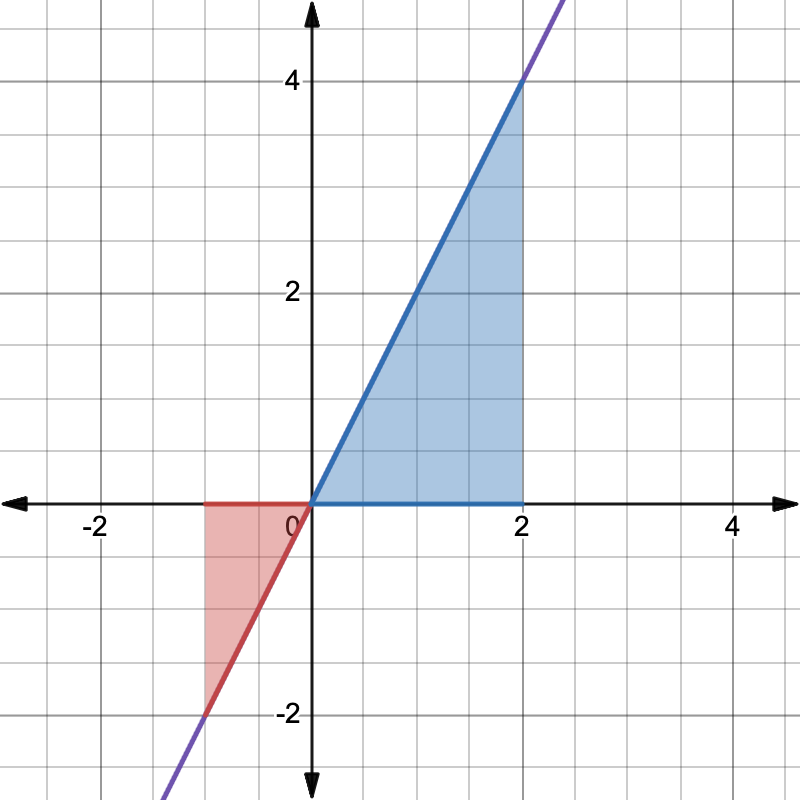
Unlike the previous example, this time we have a region under the $x$-axis. That means we’ll have to treat that area as negative.
Let’s split this up into the positive part and the negative part.
Negative Part:
- From $x = -1$ to $x = 0$
- Shape: It’s a right triangle with a base of $1$ and a height of $2$
- Area: $\frac12 b h = \frac12 (1)(2) = 1$
Positive Part:
- From $x = 0$ to $x = 2$.
- Shape: A right triangle with a base of $2$ and a height of $4$.
- Area: $\frac12 b h = \frac12 (2)(4) = 4$
Now we just subtract the negative part from the positive part:
$$ \boxed{\int_{-1}^{2} { 2x } \ dx = 4 - 1 = 3} $$
Exercise
Compute the definite integral using geometry.
$$ \int_{-2}^{3} { \frac{x}{3} } \ dx $$
Solution
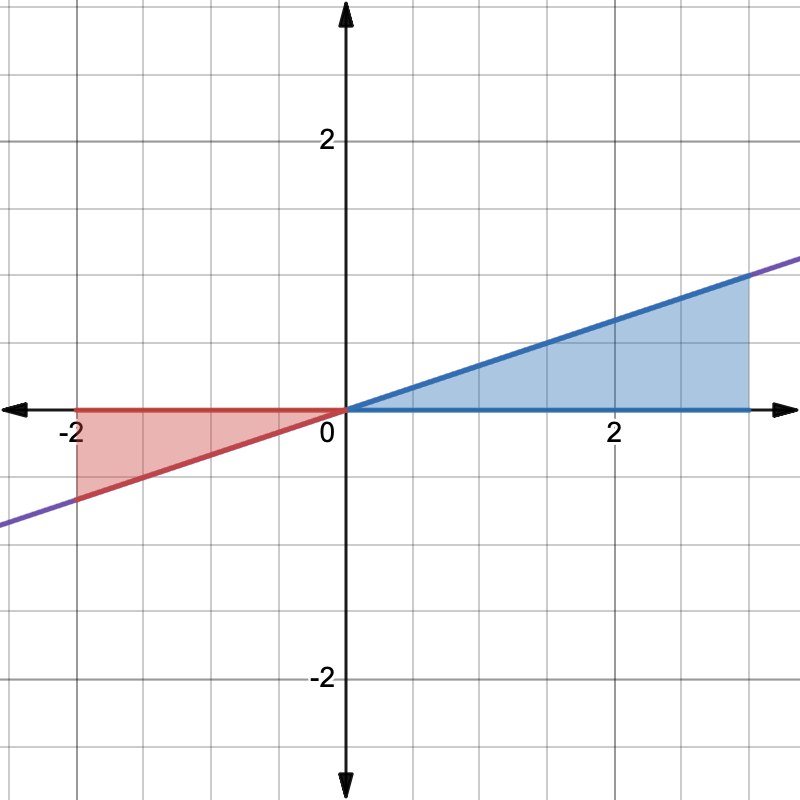
Negative Part:
- From $x = -2$ to $x = 0$
- Area: $\frac12 (2)\left(\frac23\right) = \frac23$
Positive Part:
- From $x = 0$ to $x = 3$
- Area: $\frac12 (3)(1) = \frac32$
$$\int_{-2}^{3} { \frac{x}{3} } \ dx = \frac32 - \frac23 = \boxed{\frac{5}{6}}$$
Example
We can also use the properties of integrals we outlined above. For example, if we want to evaluate
$$ \int_{0}^{4} {\left( \frac{x}{2} - 1 \right)} \ dx $$
we might use the integral of a sum property:
$$ \int_{0}^{4} {\left( \frac{x}{2} - 1 \right)} \ dx = \int_{0}^{4} { \frac{x}{2} } \ dx - \int_{0}^{4} { 1 } \ dx $$
Then, we’ve got two relatively simple integrals to evaluate:
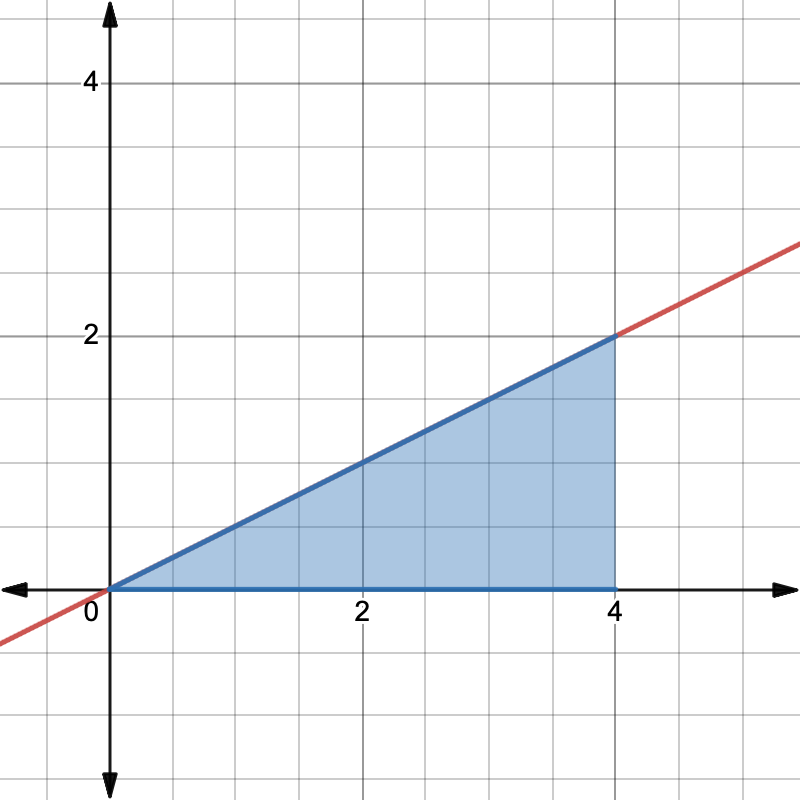
$$ \int_{0}^{4} { \frac{x}{2} } \ dx = \frac12 (4)(2) = \boxed{4} $$
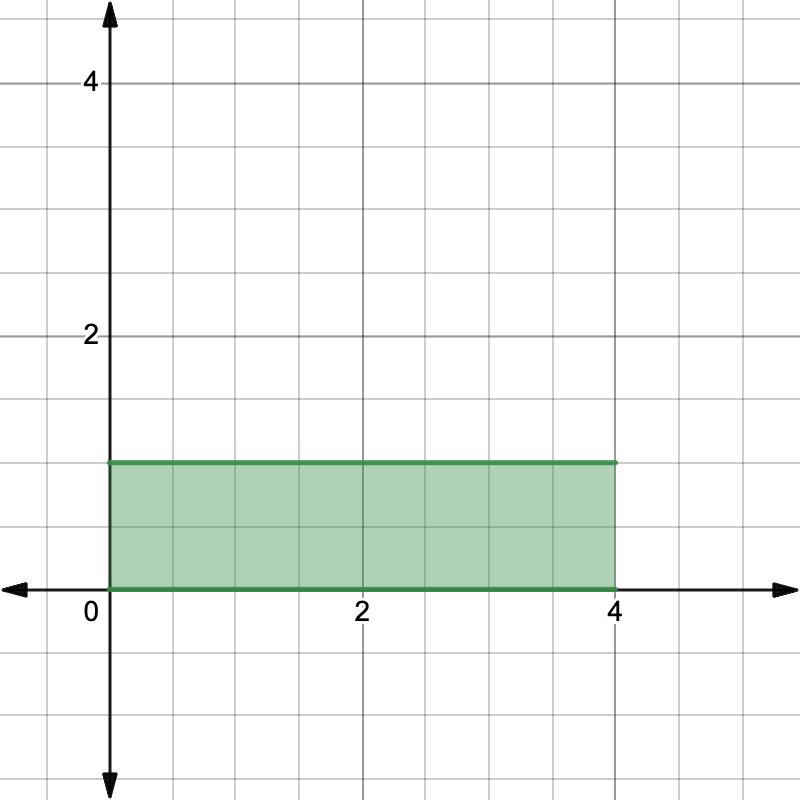
$$ \int_{0}^{4} { 1 } \ dx = (1)(4) = \boxed{4} $$
Putting it all together, we get
$$ \begin{aligned} \int_{0}^{4} {\left( \frac{x}{2} - 1 \right)} \ dx &= \int_{0}^{4} { \frac{x}{2} } \ dx - \int_{0}^{4} { 1 } \ dx\cr &= 4 + 4\cr &= \boxed{8} \end{aligned} $$
Alternatively
Exercise
Evaluate the definite integral using geometry.
$$ \int_{1}^{5} { (3 - x) } \ dx $$
Solution
We have two options:
- Break it up into $\int_{1}^{5} { 3 } \ dx$ and $\int_{1}^{5} { x } \ dx$
- Draw $y = 3 - x$ and use geometry directly
Either approach is fine. Let’s go with (2):
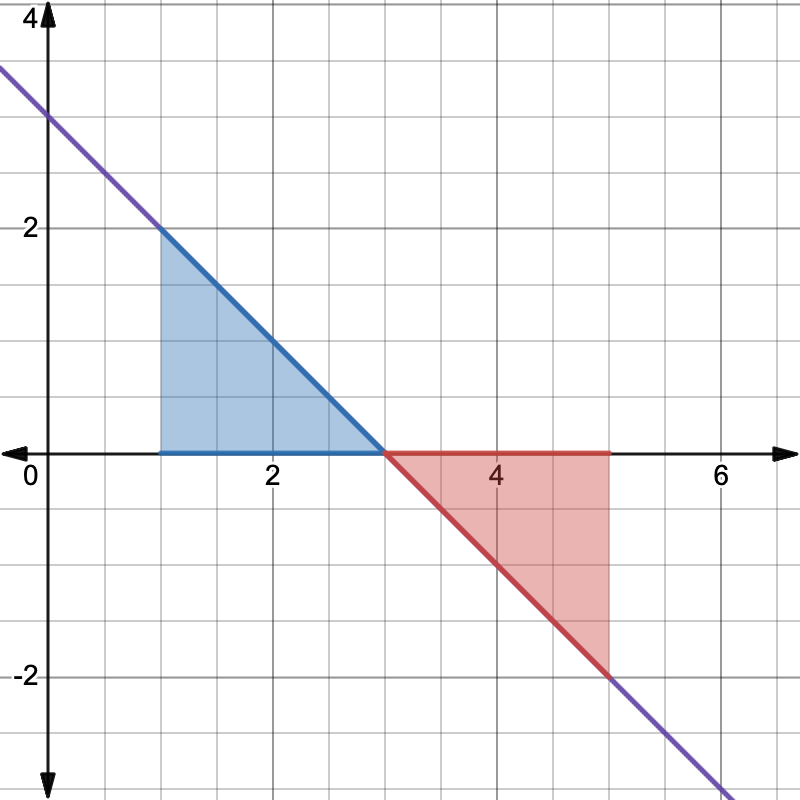
We can actually get away without doing any more work if we notice that there’s as much positive area as there is negative:
$$ \int_{1}^{5} { (3 - x) } \ dx = \boxed{0} $$
Exercise
Evaluate the definite integral using geometry.
$$ \int_{0}^{3} { \left(2x - \sqrt{9 - x^2} \right)} \ dx $$
Solution
This time, we definitely have to split it up.
$$ \int_{0}^{3} { \left(2x - \sqrt{9 - x^2} \right)} \ dx = \int_{0}^{3} { 2x} \ dx - \int_{0}^{3} {\sqrt{9 - x^2}} \ dx $$
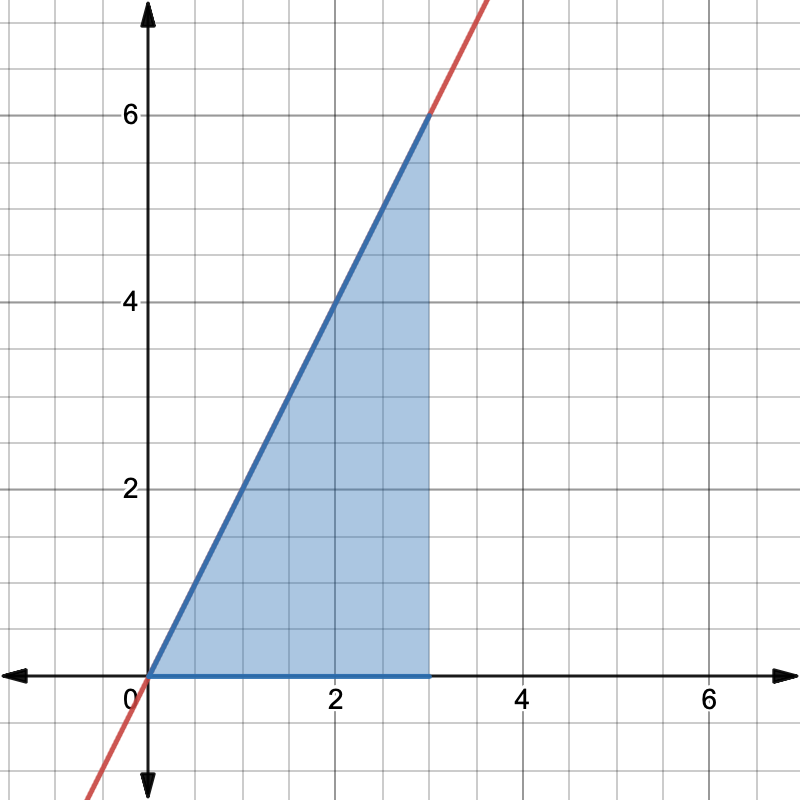
$$ \begin{aligned} \int_{0}^{3} { 2x } \ dx &= \frac12 (3)(6)\cr &=\boxed{9} \end{aligned} $$
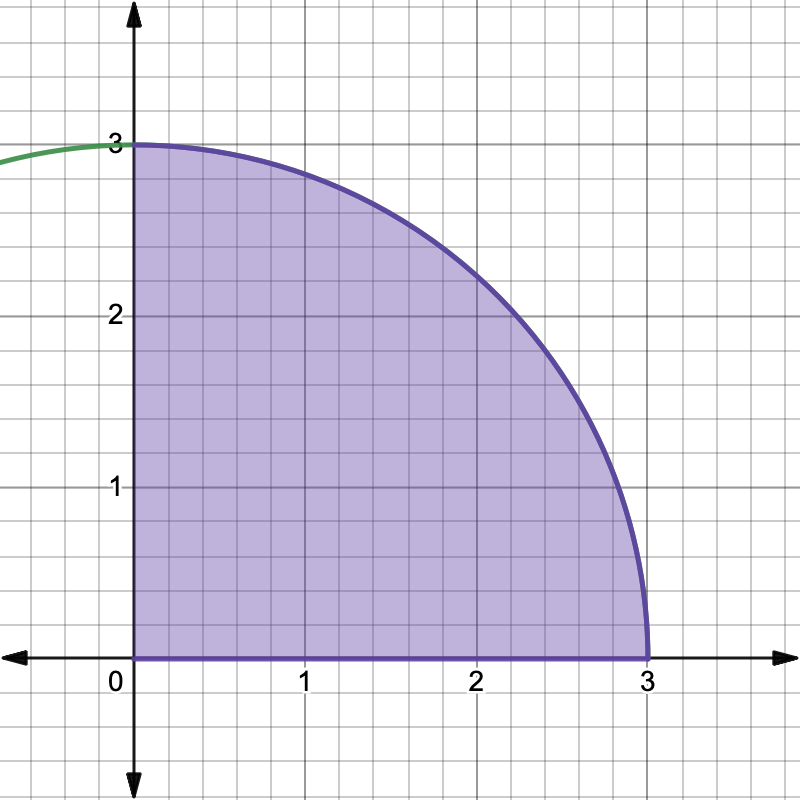
$$ \begin{aligned} \int_{0}^{3} { \sqrt{9 - x^2} } \ dx &= \frac14\pi(3)^2\cr &=\boxed{\frac{9\pi}{4}} \end{aligned} $$
$$ \int_{0}^{3} { \left(2x - \sqrt{9 - x^2} \right)} \ dx = \boxed{9 - \frac{9\pi}{4}} $$