Area Between Curves
As we saw in the area chapter, the definite integral is like a shortcut for computing the Riemann Sum, which gives us net-signed area.
$$ \boxed{\int_{a}^{b} f(x) \ dx = \text{ net-signed area between $y=f(x)$ and the $x$-axis over $[a,b]$}} $$
But, we can use definite integrals to compute more than just the net-signed area enclosed between a function’s graph and the $x$-axis. In this section, we’ll look at how we can use them compute the area enclosed between two curves.
Main Idea
Suppose we have two functions $f$ and $g$, which satisfy the following properties on the interval $[a,b]$:
- $f$ and $g$ are both continuous on the interval
- $f(x) \leq g(x)$ for all $x$ in $[a,b]$
We’ll say that $R$ is the region enclosed by the curves/lines $y=f(x)$, $y=g(x)$, $x=a$, and $x=b$. Just as we did before, we can fill $R$ with rectangles. Only now, the rectangles extend from the graph of $f$ up to the graph of $g$.

The width of each rectangle is still $\Delta x$, but the height of each rectangle is given by $g(x) - f(x)$. This gives us
$$ \boxed{\lim_{n \to \infty}\sum_{k=1}^n \overbrace{(g(x_k^{\star}) - f(x_k^{\star}))}^{\text{height}} \underbrace{\Delta x}_{\text{width}}} $$
As we now know, this Riemann Sum can be written as a definite integral and computed using the Fundamental Theorem of Calculus
$$ \boxed{\int_a^b \left(g(x) - f(x)\right) \ dx} $$
A few things to notice here:
- $g$ only needs to be greater than or equal to $f$ in the interval $[a,b]$. They can switch places elsewhere.
- The area we get here is true area rather than net-signed area. Why?
- Since $g(x) \geq f(x)$, $g(x) - f(x) \geq 0$.
- This means that the “height” of each rectangle is positive, so we don’t get any regions with “negative area.”
Example
Let’s compute the area enclosed by $y = \sqrt{x}$, $y=\frac{1}{4} x$, and $x = 4$.
Sketching a picture can be helpful.
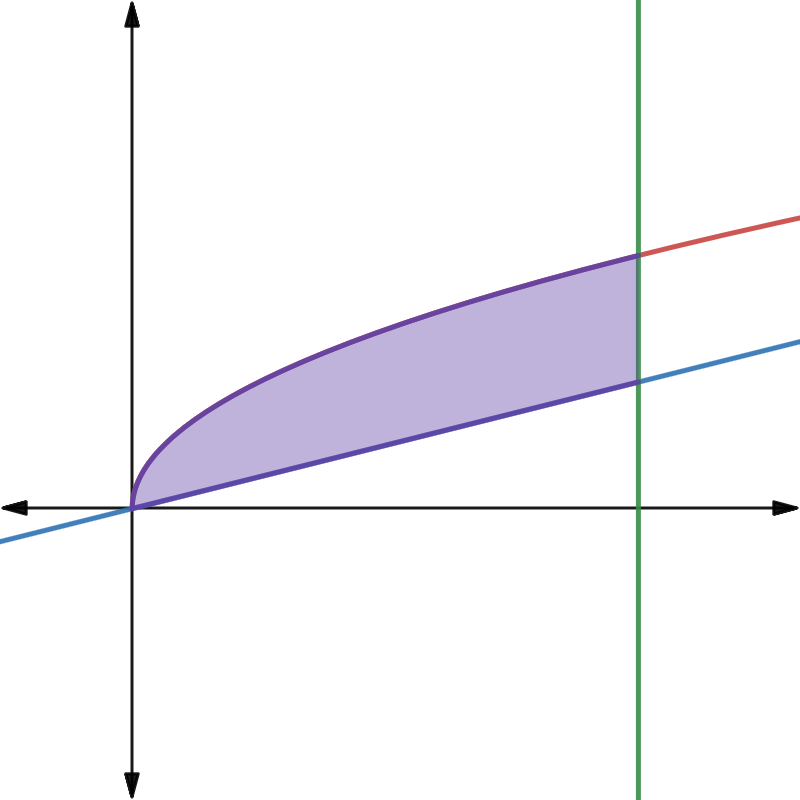
Notice that, in this case, we’re only given one $x$-value. This is because the graphs of $y = \sqrt{x}$ and $y=\frac{1}{4} x$ intersect at $x=0$. So, the interval over which we’re integrating is $[0,4]$.
$$ \begin{aligned} A &= \int_{0}^{4} \left(\sqrt{x} - \frac{1}{4} x\right) \ dx \cr &= \int_{0}^{4} \left(x^{1/2} - \frac{1}{4} x\right) \ dx \cr &= \frac{2}{3} x^{3/2} - \frac{1}{8}x^2 \biggr\rvert_{0}^{4} \cr &= \frac{2}{3} (4)^{3/2} - \frac{1}{8}(4)^2 - (0 - 0) \cr &= \frac{16}{3} - 2 \cr &= \boxed{10/3} \end{aligned} $$
Example
Let’s try another: consider the region enclosed by $y = \frac{1}{2}x^2$ and $y=x$.
Before sketching the graphs of these functions, we might find the intersection(s):
$$ \begin{aligned} \frac{1}{2}x^2 &= x \cr \frac{1}{2}x^2 - x &= 0 \cr \frac{1}{2}x(x - 2) &= 0 \cr x &= 0, 2 \end{aligned} $$
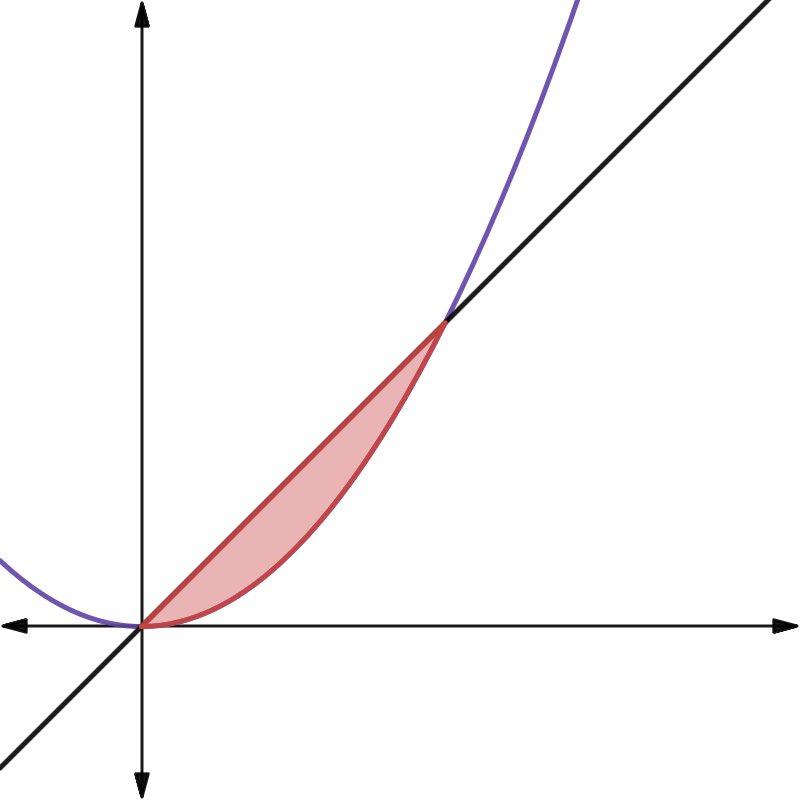
Based on our sketch, we can see that the region enclosed by these graphs is between $x=0$ and $x=2$ with $y=x$ being on top.
If your unsure about what the graphs look like and want to figure out which is on top algebraically, we can plug a number in between $0$ and $2$ in for $x$ and compare the results, like $x=1$: $$y=\frac{1}{2} x^2: \quad \frac{1}{2}(1)^2 = \frac{1}{2}$$ $$y = x: \quad (1) = 1 \ \checkmark$$ So, $y = x$ is on top.
Now we can set up an integrate:
$$ \begin{aligned} \int_{0}^{2} x - \frac{1}{2} x^2 \ dx &= \frac{1}{2}x^2 - \frac{1}{6} x^3 \biggr\rvert_{0}^{2}\cr &= \left( \frac{1}{2}(2)^2 - \frac{1}{6}(2)3 \right) - (0 - 0) \cr &= 2 - 1 \cr &= \boxed{1} \end{aligned} $$
Exercise
Set up an evaluate an integral for the area enclosed by $y = 4 - x^2$ and $y = 3x$.
Solution
We can begin by finding the intersections:
$$ \begin{aligned} 4 - x^2 &= 3x \cr x^2 + 3x - 4 &= 0 \cr (x+4)(x-1) &= 0 \cr x &= -4, 1 \end{aligned} $$

We know we’re going to integrate from $x=-4$ to $x = 1$. To figure out which curve is on top in that interval, we can either plug in a value in that interval (like $x = 0$) or sketch the graph.
Testing $x = 0$:
$$4 - 0^2 = 4 \text{ is greater than } 3(0) = 0$$
We get the following:
$$ \begin{aligned} \int_{-4}^{1} (4 - x^2) - (3x) \ dx &= \int_{-4}^{1} 4 - x^2 - 3x \ dx \cr &= 4x - \frac{1}{3} x^3 - \frac{3}{2} x^2 \biggr\rvert_{-4}^{1} \cr &= \left( 4(1) - \frac{1}{3} (1)^3 - \frac{3}{2} (1)^2 \right) - \left( 4(-4) - \frac{1}{3} (-4)^3 - \frac{3}{2} (-4)^2 \right) \cr &= \left( 4 - \frac{1}{3} - \frac{3}{2} \right) - \left( -16 + \frac{64}{3} - 24\right) \cr &= 44 - \frac{65}{3} - \frac{3}{2} \cr &= \frac{125}{6} \end{aligned} $$
Example
What if we have more than two curves?
Consider the region enclosed by $y = \frac{2}{x}$, $y = \frac{1}{2}x$, and $y = 4$.

We can start by finding all of the pairwise intersections:
- $\frac{2}{x}= \frac{1}{2}x \Longrightarrow x = \pm 2$
- $\frac{2}{x} = 2 \Longrightarrow x = 1$
- $\frac{1}{2}x = 2 \Longrightarrow x = 4$
A sketch at this point would be helpful.
Notice that the bottom boundary of the region changes at $x = 1.$ We have to integrate “top - bottom,” so we’ll have to split the region into two integrals:
$$ \begin{aligned} A &= \int_{1}^{2} 2 - \frac{2}{x} \ dx + \int_{2}^{4} 2 - \frac{1}{2} x \ dx \cr &= 2x - 2\ln|x| \biggr\rvert_{1}^{2} + 2x - \frac{1}{4} x^2 \biggr\rvert_{2}^{4}\cr &= \left[\left( 2(2) - 2\ln(2) \right) - \left( 2\left( 1 \right)- 2\ln\left( 1 \right) \right)\right] + \left[\left( 2(4) - \frac{1}{4}(4)^2 \right) - \left( 2(2) - \frac{1}{4}(2)^2 \right)\right] \cr &= \left[\left( 4 - 2\ln(2) \right) - \left( 2 - 0 \right)\right] + \left[\left( 8 - 4 \right) - \left( 4 - 1\right)\right] \cr &= \left[2 - 2\ln(2)\right] + \left[1\right] \cr &= \boxed{3 - 2\ln 2} \end{aligned} $$
Well, that was pretty tedious. Fortunately, we can set find this area much more easily if we change perspective. Rather than integrating interms of $x$, we can integrate in terms of $y$. To do this, we’ll have to rewrite each curve/line as a function of $y$, rather than $x$.
- $y = 2/x \Longrightarrow x = 2/y$
- $y = x/2 \Longrightarrow x = 2y$
These intersect at $y = 2$. We can see this by setting them equal and solving ($2/y = 2y$) or, since we alread found the $x$-value of the point of intersection, by plugging $x=2$ into either: $x = 2/(2) = 1$.
Our $y$-setup looks like this:
$$ \begin{aligned} \int_{1}^{2} 2y - \frac{2}{y} \ dy &= y^2 - 2\ln |y| \biggr\rvert_{2}^{4} \cr &= \left( 2^2 - 2\ln |2| \right) - \left( 1^2 - 2\ln |1| \right) \cr &= \boxed{3 - 2\ln 2} \end{aligned} $$
Either way, we get the same answer, but the second method is much less tedious!
In the example above, we saw one reason why we might want to integrate in terms of $y$ rather than $x$: we were able to compute the area with one integral rather than two. So, it was the shape of the region that made one easier than the other.
Another possibility is that the function we’re trying to integrate has a complicated antiderivative. It might be the case that the inverse of such a function is easier to integrate. For example, $\ln x$ is hard to integrate, but $e^x$ is not. Similarly, $\arcsin x$ is hard to integrate, but $\sin x$ is not.
Example
Consider region enclosed by $y = \ln x,$ $y = 2,$ and $x = 1$.
First, we’ll find the intersection of $y = \ln x$ and $y = 2$:
$$ \begin{aligned} \ln x &= 2 \cr x &= e^2 \end{aligned} $$
We can set up the region in question as follows:
$$ \int_{1}^{e^2} 2 - \ln x \ dx $$
There’s a problem here: we haven’t yet figured out how to integrate $\ln x.$ We’ll come back to this in a later section. For now, let’s see if we can set this integral up in terms of $y$ instead.
We need to rewrite $y = \ln x$ as a function of $y$ by solving for $x\text{:}$ $x = e^y$.
This gives us
$$ \begin{aligned} \int_{0}^{2} e^y - 1 \ dy &= e^y - y \biggr\rvert_{0}^{2} \cr &= (e^2 - 2) - (e^0 - 0) \cr &= e^2 - 2 - 1 \cr &= \boxed{e^2 - 3} \end{aligned} $$
Exercise
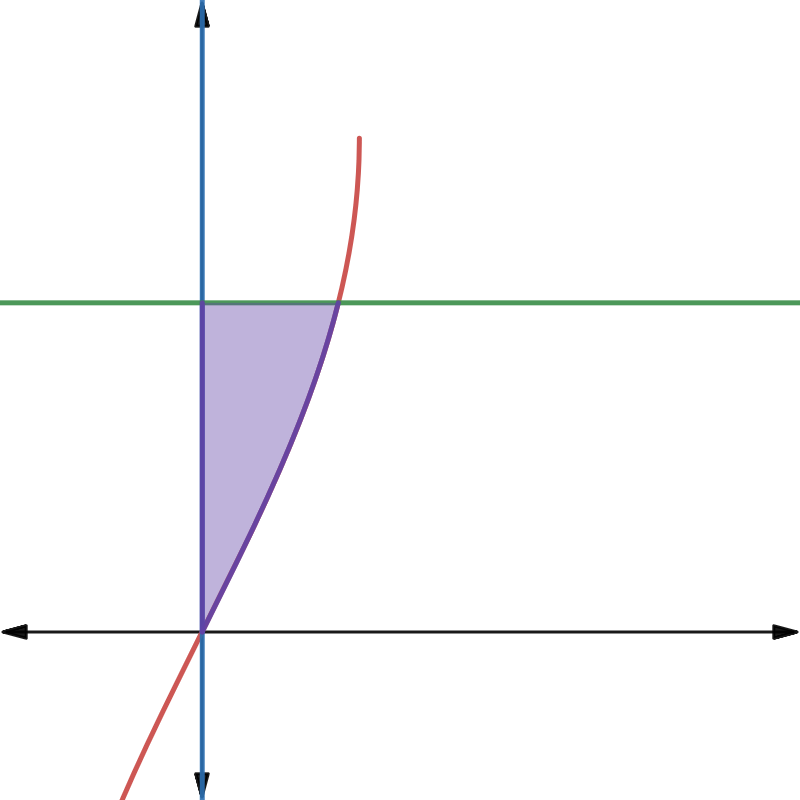
Find the area of the region enclosed by $y = \arcsin 2x,$ $y = \frac{\pi}{3},$ and $x = 0$.
Solution
Since we can’t integrate $\arcsin 2x$ (yet!), we should set this up as a $y$-integral.
$$ \begin{aligned} y &= \arcsin 2x \cr \sin y &= 2x \cr x &= \frac{1}{2}\sin y \end{aligned} $$
For the intersection of $x = \frac{1}{2} \sin y$ and $x = 0$, we have $y = 0$ (since $\sin 0 = 0$):
$$ \begin{aligned} A &= \int_{0}^{\pi/3} \frac{1}{2} \sin y - 0 \ dy \cr &= -\frac{1}{2} \cos y \biggr\rvert_{0}^{\pi/3} \cr &= -\frac{1}{2} \left( \cos \frac{\pi}{3} - \cos 0 \right) \cr &= -\frac{1}{2} \left( \frac{1}{2} - 1 \right) \cr &= \boxed{\frac{1}{4}} \end{aligned} $$